ANENG B20 LCD Digital Voltage Tester Pen
Official Store Deal
Expert Analysis Overview
Precision Electrical Diagnostics: The ANENG B20 Tester
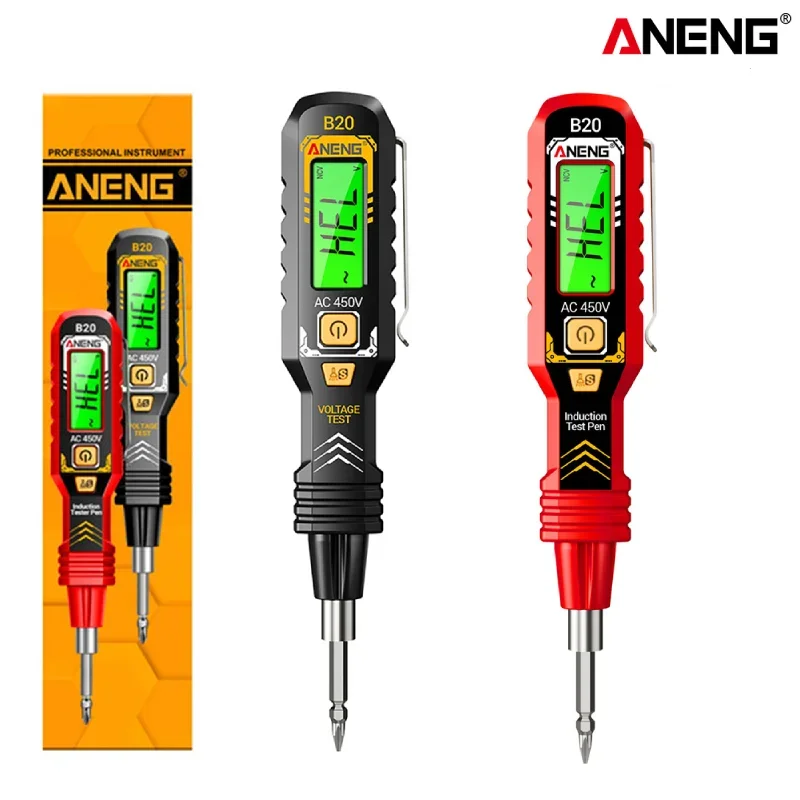
The ANENG B20 LCD Digital Voltage Tester is a compact, multi-functional electrical diagnostic tool engineered for both professional electricians and diligent DIY enthusiasts. This device integrates non-contact voltage detection, live/neutral wire identification, and a continuity test within a durable, pen-style form factor. Its design prioritizes user safety and operational efficiency, offering a clear digital display and audible alerts for critical measurements. The B20 represents a significant upgrade over basic test lights, providing quantifiable data and enhanced safety features for routine electrical checks.Core Metrological Capabilities
#
AC Voltage Measurement Range
The ANENG B20 offers a dual-mode AC voltage measurement capability. Non-contact voltage (NCV) detection spans from 30V to 1000V AC, providing a broad range for identifying energized circuits without direct contact. This non-invasive method significantly enhances safety during initial assessments. Contact measurement, conversely, operates within a narrower but still practical range of 11V to 450V AC. This allows for more precise readings when direct circuit engagement is necessary.The practical implication of these ranges is comprehensive utility. Users can quickly scan for the presence of voltage in wall outlets, cables, and circuit breakers from a safe distance. For more specific diagnostic tasks, such as verifying line voltage or troubleshooting appliance circuits, the contact mode delivers the required precision. This dual approach ensures adaptability across various electrical scenarios.
Compared to rudimentary voltage pens that often only provide a simple 'on/off' indication, the B20's specified ranges offer a quantifiable assessment of voltage presence. This allows for a more informed decision-making process regarding circuit status. It provides actual numerical values.
#
Frequency Response and Stability
The device is calibrated to operate effectively within a standard frequency range of 50-60Hz. This covers the typical alternating current frequencies found in most residential and commercial power grids globally. Consistent performance is expected within this band.Operating within this defined frequency window ensures that voltage readings remain stable and accurate. Deviations outside this range could potentially affect measurement integrity, but for standard applications, this specification is entirely adequate. The device maintains its metrological integrity.
Many basic testers do not specify a frequency range, implying a less controlled measurement environment. The B20's explicit 50-60Hz specification indicates a design optimized for common electrical systems. This is a critical detail for reliable operation.
#
Inductive Sensitivity and Indication
Inductive sensitivity is a key feature for non-contact detection, and the B20 provides a three-grid scale indication. This visual feedback system uses a series of dashes ('-', '--', '---') to represent increasing electric field strength, correlating to medium and strong electric fields. This visual cue complements the audible alarm.This graduated sensitivity allows users to gauge the proximity and intensity of an electrical field. A single dash might indicate a distant or weaker field, while three dashes signify a strong, immediate presence of voltage. This nuanced feedback is crucial for pinpointing live wires accurately. It helps prevent accidental contact.
Unlike simpler NCV testers that offer only a binary 'yes/no' voltage detection, the B20's multi-level indication provides a more granular understanding of the electrical environment. This enhances both safety and diagnostic capability. It offers superior situational awareness.
Operational Enhancements and Ergonomics
#
Live/Neutral Wire Recognition
The ANENG B20 incorporates a distinct live and neutral wire recognition system. When the electric pen is inserted into a socket, the screen displays a bright red color and activates a buzzer for a live line. Conversely, a green screen with no buzzer alarm indicates a neutral line. This visual and auditory differentiation is immediate.This clear distinction simplifies the often-confusing task of identifying live and neutral conductors. It eliminates guesswork, which is paramount for safety during wiring tasks or troubleshooting. The color-coded feedback is intuitive. It reduces potential errors.
Traditional methods often involve trial and error with a single-indicator tester, or require a multimeter. The B20 streamlines this process, offering an integrated, unambiguous solution. This feature significantly improves workflow efficiency.
#
LCD Display and Backlight
The device features an LCD display that automatically illuminates after three seconds of power-on. This backlight ensures clear visibility of readings even in dimly lit environments. The two-color screen display further enhances readability, particularly for live/neutral identification.Visibility is paramount for accurate readings, especially in confined spaces or during power outages. The backlit screen ensures that numerical values and indicators are always discernible, reducing eye strain and potential misinterpretations. Clear data is always available.
Many entry-level testers rely solely on LED indicators or unlit screens, which can be challenging to read in poor lighting. The B20's dedicated LCD with backlight provides a superior user experience. It offers enhanced clarity.
#
Integrated Screwdriver Bits
A practical addition to the B20's design is the inclusion of interchangeable screwdriver bits. The device comes with both a cross-head and a one-word (flat-head) screwdriver bit. These are durable and easily switched, adding versatility to the tool. This integration is highly convenient.This feature transforms the voltage tester into a multi-purpose tool, eliminating the need to carry a separate screwdriver for minor adjustments or terminal access. It streamlines the toolkit for electricians and technicians. One tool handles multiple tasks.
Unlike dedicated voltage testers, which require users to carry additional tools, the B20's integrated screwdriver bits offer a compact and efficient solution. This reduces clutter and improves on-site readiness. It is a thoughtful design choice.
#
Pen Holder Design and Portability
The ANENG B20 is designed with a portable pen holder clip on its side. This allows the device to be securely attached to a shirt pocket, belt, or tool pouch. Its lightweight construction, at just 48g, further enhances its portability. Easy access is always maintained.This design element ensures that the tester is always within reach, ready for immediate use. Professionals working in various locations will appreciate the convenience of not having to search for their tool. It is always at hand.
Many larger multimeters or bulkier testers lack such integrated portability features, making them less convenient for quick checks. The B20's pen-style form factor and clip make it an ideal everyday carry item. It is exceptionally portable.
Safety and Durability Considerations
#
Security Level and Material Construction
The ANENG B20 boasts a CE CAT. II 1000V/CATIV 600V security level, indicating its suitability for various electrical environments, including distribution systems and main installations. The device's casing is constructed from ABS material, known for its impact resistance and durability. This robust material protects internal components.This high safety rating signifies that the device has been tested and certified to withstand significant transient overvoltages, crucial for user protection. The ABS housing provides a resilient shell against drops and daily wear. Safety is a primary concern.
Compared to unrated or lower-category testers, the B20's CAT. II 1000V/CATIV 600V rating provides a higher degree of confidence in its safety performance. The ABS material choice ensures longevity in demanding work environments. It is built to last.
#