AMS1117 Series Voltage Regulators (10-Pack)
Official Store Deal
Expert Analysis Overview
The AMS1117 Series Voltage Regulators are essential, cost-effective linear voltage regulation components tailored for small-batch electronics production and rapid prototyping, offering stable power delivery in a compact footprint. This particular offering provides a convenient 10-pack of these crucial integrated circuits, catering directly to the needs of developers and manufacturers who require consistent, reliable power solutions without the overhead of bulk purchasing. Its design prioritizes straightforward integration into diverse electronic systems. Simplicity is key.
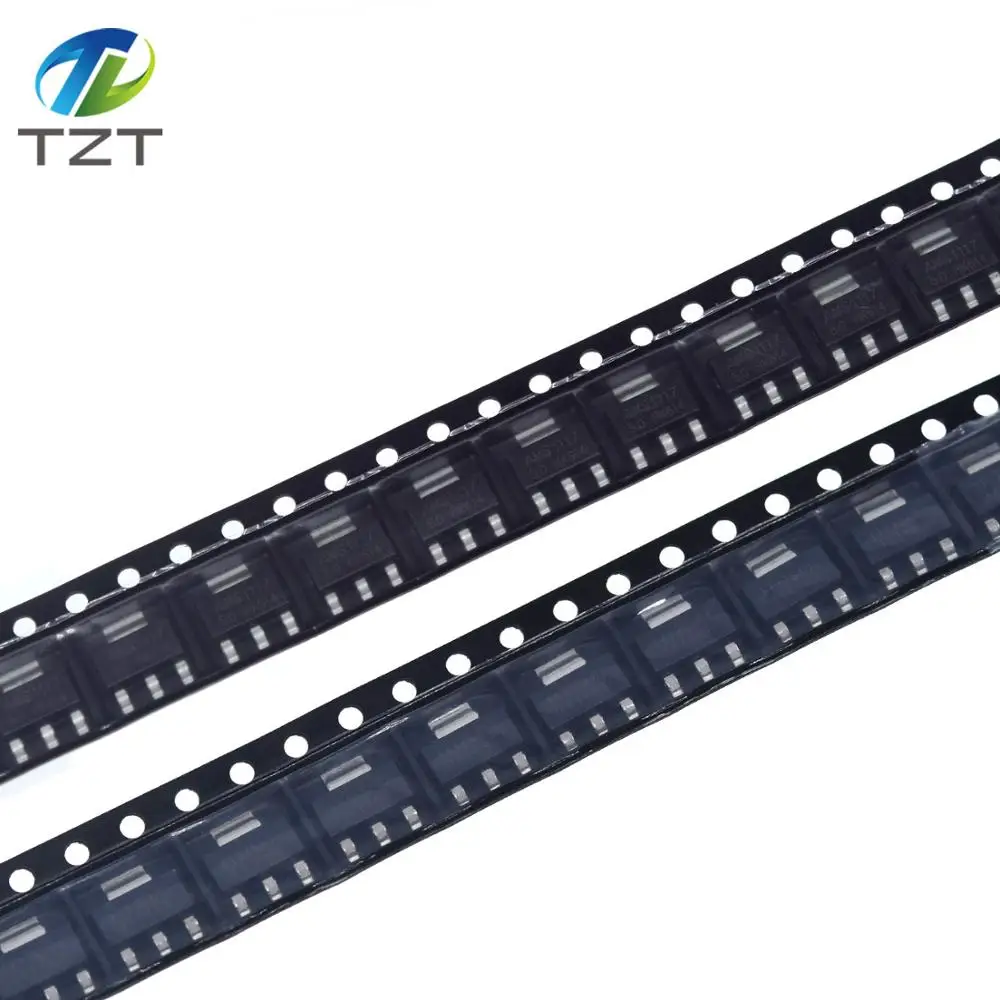
The physical form factor of these regulators, primarily the SOT-223 surface-mount package, is a significant advantage for modern PCB design and assembly processes. This compact footprint allows for dense component placement, which is critical in space-constrained applications such as wearable technology, IoT devices, or miniature control boards. The visible tape-and-reel packaging further streamlines assembly, making them suitable for both manual placement in prototype stages and automated pick-and-place machines during small production runs. This efficiency is paramount. Unlike more complex switching regulators that can introduce electromagnetic interference (EMI) into sensitive circuits, the AMS1117, as a linear regulator, offers a cleaner output voltage. This characteristic is invaluable for powering analog sensors, audio circuits, or precision measurement systems where noise can severely degrade performance. The availability of multiple fixed voltage options—1.2V, 1.5V, 1.8V, 2.5V, 3.3V, and 5.0V—directly addresses common logic and supply rail requirements, eliminating the need for external resistor dividers for these standard voltages. Design complexity reduces. The adjustable (ADJ) variant, conversely, provides the flexibility to dial in any specific voltage within its operational range, offering a single component solution for bespoke power needs. This versatility saves time.
These AMS1117 regulators are designed to convert a higher input voltage into a stable, lower output voltage. The fixed voltage versions are pre-configured to output specific voltages, which means no external components are needed to set the output level. This simplifies circuit design considerably for standard applications. For instance, an AMS1117-3.3V will reliably provide 3.3 volts from an input ranging from approximately 4.5V up to 15V. This directness is a major benefit.
For small-batch manufacturers, this simplifies the bill of materials and reduces assembly errors. Imagine a production line where each board needs a 3.3V rail for a microcontroller and a 1.8V rail for a memory chip. Using dedicated fixed-voltage AMS1117 parts for each eliminates the need to calculate and solder multiple precision resistors for adjustable regulators. This reduces component count. The clean, stable output is particularly beneficial for digital logic, where voltage fluctuations can lead to unpredictable behavior or data corruption. Consistent power ensures reliable operation.
Compared to using a single, more powerful adjustable regulator with a complex resistor network, employing these dedicated fixed-voltage AMS1117 units offers a more robust and less error-prone solution for common voltage requirements. It removes the potential for human error in resistor selection or soldering. Furthermore, the low quiescent current of these devices, while not ultra-low power, makes them suitable for many always-on applications without excessive power draw. This efficiency is acceptable.
The presentation of these components in tape-and-reel packaging is not merely a convenience; it is a fundamental aspect of efficient electronics manufacturing. Each component is precisely positioned within a carrier tape, ready for automated handling. This standardized packaging format is universally compatible with pick-and-place machines, which are central to modern surface-mount technology (SMT) assembly lines. Speed is a priority.
For a small-batch manufacturer, this directly translates to faster changeover speeds between different product runs. Instead of individually handling loose components, which is time-consuming and prone to errors, an entire reel can be loaded into an assembly machine. This significantly reduces the manual labor involved in populating PCBs. It also ensures consistent component orientation and placement, leading to higher quality assemblies and fewer rework cycles. This consistency is crucial.
Unlike through-hole components that require manual insertion or wave soldering, the SOT-223 package is designed for reflow soldering processes. This allows for a streamlined, single-pass assembly process for all surface-mount components on a board. Optimizing the assembly process minimizes both labor costs and manufacturing time, directly impacting the profitability of small-volume production. This saves money. By leveraging such industry-standard packaging, manufacturers can maintain tighter control over their production schedules and quality, avoiding the delays and potential inconsistencies associated with outsourcing assembly to third parties.
As linear regulators, AMS1117 devices dissipate excess input voltage as heat. While the SOT-223 package is compact, its design includes a larger central pad for improved thermal transfer to the PCB. Proper thermal management is essential for the long-term reliability of any electronic device. Heat is the enemy. Understanding the power dissipation (P_diss = (V_inV_out) * I_out) is critical when designing a circuit with these regulators, especially when operating at higher currents or with significant input-output voltage differentials.
In a typical application, the PCB itself acts as a heatsink, with copper pours connected to the regulator's ground/thermal pad helping to dissipate heat. For demanding applications, designers must ensure sufficient copper area or consider external heatsinks, though this adds complexity. Overheating can lead to the regulator entering thermal shutdown, causing intermittent operation, or eventually leading to permanent damage. This must be avoided. Proactive thermal design ensures the regulator operates within its safe operating area, guaranteeing stable voltage output even under continuous load.
Compared to simply dropping voltage with a resistor, which offers no regulation and can be highly inefficient, the AMS1117 provides a regulated output with built-in thermal and current limiting protection. This integrated protection safeguards the device itself and, by extension, the entire circuit it powers. This adds robustness. For small batch production, where every unit's reliability contributes to brand reputation, choosing components with such inherent safety features is a wise investment, minimizing field failures and customer support issues.
The offering of these AMS1117 regulators in a 10-piece lot at an accessible price point is a strategic advantage for small-batch manufacturers and hobbyists. It strikes a balance between bulk purchasing discounts and the practical needs of smaller projects. This avoids overstocking. For prototyping, having a small quantity of various voltage regulators on hand allows for quick experimentation and iteration without committing to large, expensive reels of components. Design freedom increases.
This cost structure directly supports iterative design processes. Engineers can test different voltage rails or power configurations without incurring significant component costs for each iteration. This encourages innovation. The low unit cost also means that even if a few components are damaged during assembly or testing, the financial impact is minimal, reducing the barrier to entry for complex projects. Mistakes are less costly.
Framing this against outsourcing component sourcing, the ability to purchase these essential parts in smaller, affordable quantities allows manufacturers to maintain greater control over their supply chain and costs. It reduces reliance on minimum order quantities (MOQs) from larger distributors, which can be prohibitive for small businesses. This independence is valuable. By keeping component costs low and assembly efficient, small-batch manufacturers can produce high-quality products at competitive prices, directly impacting their market viability and profitability.
The comprehensive range of fixed output voltages, alongside the adjustable variant, makes the AMS1117 series exceptionally versatile. From 1.2V for core logic power in FPGAs to 5.0V for USB-powered devices or standard TTL logic, these regulators cover a vast spectrum of common electronic requirements. Diverse needs are met. The adjustable version (AMS1117-ADJ) further extends this utility, allowing designers to create custom voltage rails for specific sensors, analog front-ends, or non-standard microcontrollers. Customization is simple.
Consider a scenario where a single product line might have several variations, each requiring slightly different internal voltages. Instead of stocking a unique regulator for every single voltage, a manufacturer can standardize on the AMS1117 series. This simplifies inventory management. For instance, one product might use the 3.3V version, while another, perhaps a low-power variant, uses the 1.8V version, all from the same component family. This streamlines procurement.
This versatility means that a small batch manufacturer can cover a wide array of product designs with a relatively small inventory of AMS1117 parts. This reduces complexity. It simplifies design decisions and accelerates the development process, as engineers are already familiar with the characteristics and application guidelines of the series. This familiarity speeds up design. The AMS1117 is a workhorse component, proving its utility across countless embedded systems and consumer electronics applications, making it a reliable choice for new designs.
For the small-batch manufacturer, the AMS1117 series represents more than just a component; it embodies a strategy for maintaining quality control and avoiding outsourcing costs. By integrating these reliable, well-understood regulators, manufacturers can ensure a consistent power foundation for their products. This builds trust. The ability to prototype and produce short runs in-house, leveraging components like the AMS1117, means that every stage of development and production remains under direct supervision. This control is absolute.
Imagine efficiently assembling your custom electronics, knowing each board delivers stable, clean power from these dependable regulators. You will experience fewer unexpected glitches, smoother testing phases, and ultimately, a higher yield of functional products. Your customers will appreciate the consistent performance and reliability of devices powered by such robust components, reinforcing your brand's reputation for quality. This leads to customer satisfaction. You will confidently launch new products, secure in the knowledge that your power delivery solutions are both economical and engineered for steadfast operation, all while keeping your production costs low and your quality standards high.
The physical form factor of these regulators, primarily the SOT-223 surface-mount package, is a significant advantage for modern PCB design and assembly processes. This compact footprint allows for dense component placement, which is critical in space-constrained applications such as wearable technology, IoT devices, or miniature control boards. The visible tape-and-reel packaging further streamlines assembly, making them suitable for both manual placement in prototype stages and automated pick-and-place machines during small production runs. This efficiency is paramount. Unlike more complex switching regulators that can introduce electromagnetic interference (EMI) into sensitive circuits, the AMS1117, as a linear regulator, offers a cleaner output voltage. This characteristic is invaluable for powering analog sensors, audio circuits, or precision measurement systems where noise can severely degrade performance. The availability of multiple fixed voltage options—1.2V, 1.5V, 1.8V, 2.5V, 3.3V, and 5.0V—directly addresses common logic and supply rail requirements, eliminating the need for external resistor dividers for these standard voltages. Design complexity reduces. The adjustable (ADJ) variant, conversely, provides the flexibility to dial in any specific voltage within its operational range, offering a single component solution for bespoke power needs. This versatility saves time.
Core Functionality: Precision Power Delivery
These AMS1117 regulators are designed to convert a higher input voltage into a stable, lower output voltage. The fixed voltage versions are pre-configured to output specific voltages, which means no external components are needed to set the output level. This simplifies circuit design considerably for standard applications. For instance, an AMS1117-3.3V will reliably provide 3.3 volts from an input ranging from approximately 4.5V up to 15V. This directness is a major benefit.
For small-batch manufacturers, this simplifies the bill of materials and reduces assembly errors. Imagine a production line where each board needs a 3.3V rail for a microcontroller and a 1.8V rail for a memory chip. Using dedicated fixed-voltage AMS1117 parts for each eliminates the need to calculate and solder multiple precision resistors for adjustable regulators. This reduces component count. The clean, stable output is particularly beneficial for digital logic, where voltage fluctuations can lead to unpredictable behavior or data corruption. Consistent power ensures reliable operation.
Compared to using a single, more powerful adjustable regulator with a complex resistor network, employing these dedicated fixed-voltage AMS1117 units offers a more robust and less error-prone solution for common voltage requirements. It removes the potential for human error in resistor selection or soldering. Furthermore, the low quiescent current of these devices, while not ultra-low power, makes them suitable for many always-on applications without excessive power draw. This efficiency is acceptable.
Manufacturing Efficiency: Streamlined Assembly
The presentation of these components in tape-and-reel packaging is not merely a convenience; it is a fundamental aspect of efficient electronics manufacturing. Each component is precisely positioned within a carrier tape, ready for automated handling. This standardized packaging format is universally compatible with pick-and-place machines, which are central to modern surface-mount technology (SMT) assembly lines. Speed is a priority.
For a small-batch manufacturer, this directly translates to faster changeover speeds between different product runs. Instead of individually handling loose components, which is time-consuming and prone to errors, an entire reel can be loaded into an assembly machine. This significantly reduces the manual labor involved in populating PCBs. It also ensures consistent component orientation and placement, leading to higher quality assemblies and fewer rework cycles. This consistency is crucial.
Unlike through-hole components that require manual insertion or wave soldering, the SOT-223 package is designed for reflow soldering processes. This allows for a streamlined, single-pass assembly process for all surface-mount components on a board. Optimizing the assembly process minimizes both labor costs and manufacturing time, directly impacting the profitability of small-volume production. This saves money. By leveraging such industry-standard packaging, manufacturers can maintain tighter control over their production schedules and quality, avoiding the delays and potential inconsistencies associated with outsourcing assembly to third parties.
Thermal Management and Reliability
As linear regulators, AMS1117 devices dissipate excess input voltage as heat. While the SOT-223 package is compact, its design includes a larger central pad for improved thermal transfer to the PCB. Proper thermal management is essential for the long-term reliability of any electronic device. Heat is the enemy. Understanding the power dissipation (P_diss = (V_in
In a typical application, the PCB itself acts as a heatsink, with copper pours connected to the regulator's ground/thermal pad helping to dissipate heat. For demanding applications, designers must ensure sufficient copper area or consider external heatsinks, though this adds complexity. Overheating can lead to the regulator entering thermal shutdown, causing intermittent operation, or eventually leading to permanent damage. This must be avoided. Proactive thermal design ensures the regulator operates within its safe operating area, guaranteeing stable voltage output even under continuous load.
Compared to simply dropping voltage with a resistor, which offers no regulation and can be highly inefficient, the AMS1117 provides a regulated output with built-in thermal and current limiting protection. This integrated protection safeguards the device itself and, by extension, the entire circuit it powers. This adds robustness. For small batch production, where every unit's reliability contributes to brand reputation, choosing components with such inherent safety features is a wise investment, minimizing field failures and customer support issues.
Cost-Effectiveness for Prototyping and Production
The offering of these AMS1117 regulators in a 10-piece lot at an accessible price point is a strategic advantage for small-batch manufacturers and hobbyists. It strikes a balance between bulk purchasing discounts and the practical needs of smaller projects. This avoids overstocking. For prototyping, having a small quantity of various voltage regulators on hand allows for quick experimentation and iteration without committing to large, expensive reels of components. Design freedom increases.
This cost structure directly supports iterative design processes. Engineers can test different voltage rails or power configurations without incurring significant component costs for each iteration. This encourages innovation. The low unit cost also means that even if a few components are damaged during assembly or testing, the financial impact is minimal, reducing the barrier to entry for complex projects. Mistakes are less costly.
Framing this against outsourcing component sourcing, the ability to purchase these essential parts in smaller, affordable quantities allows manufacturers to maintain greater control over their supply chain and costs. It reduces reliance on minimum order quantities (MOQs) from larger distributors, which can be prohibitive for small businesses. This independence is valuable. By keeping component costs low and assembly efficient, small-batch manufacturers can produce high-quality products at competitive prices, directly impacting their market viability and profitability.
Application Versatility: Beyond Basic Regulation
The comprehensive range of fixed output voltages, alongside the adjustable variant, makes the AMS1117 series exceptionally versatile. From 1.2V for core logic power in FPGAs to 5.0V for USB-powered devices or standard TTL logic, these regulators cover a vast spectrum of common electronic requirements. Diverse needs are met. The adjustable version (AMS1117-ADJ) further extends this utility, allowing designers to create custom voltage rails for specific sensors, analog front-ends, or non-standard microcontrollers. Customization is simple.
Consider a scenario where a single product line might have several variations, each requiring slightly different internal voltages. Instead of stocking a unique regulator for every single voltage, a manufacturer can standardize on the AMS1117 series. This simplifies inventory management. For instance, one product might use the 3.3V version, while another, perhaps a low-power variant, uses the 1.8V version, all from the same component family. This streamlines procurement.
This versatility means that a small batch manufacturer can cover a wide array of product designs with a relatively small inventory of AMS1117 parts. This reduces complexity. It simplifies design decisions and accelerates the development process, as engineers are already familiar with the characteristics and application guidelines of the series. This familiarity speeds up design. The AMS1117 is a workhorse component, proving its utility across countless embedded systems and consumer electronics applications, making it a reliable choice for new designs.
The Manufacturer's Edge: Quality and Control
For the small-batch manufacturer, the AMS1117 series represents more than just a component; it embodies a strategy for maintaining quality control and avoiding outsourcing costs. By integrating these reliable, well-understood regulators, manufacturers can ensure a consistent power foundation for their products. This builds trust. The ability to prototype and produce short runs in-house, leveraging components like the AMS1117, means that every stage of development and production remains under direct supervision. This control is absolute.
Imagine efficiently assembling your custom electronics, knowing each board delivers stable, clean power from these dependable regulators. You will experience fewer unexpected glitches, smoother testing phases, and ultimately, a higher yield of functional products. Your customers will appreciate the consistent performance and reliability of devices powered by such robust components, reinforcing your brand's reputation for quality. This leads to customer satisfaction. You will confidently launch new products, secure in the knowledge that your power delivery solutions are both economical and engineered for steadfast operation, all while keeping your production costs low and your quality standards high.