ALLSOME 2-in-1 Milling Drilling Precision Vise & Swivel Table
Official Store Deal
Expert Analysis Overview
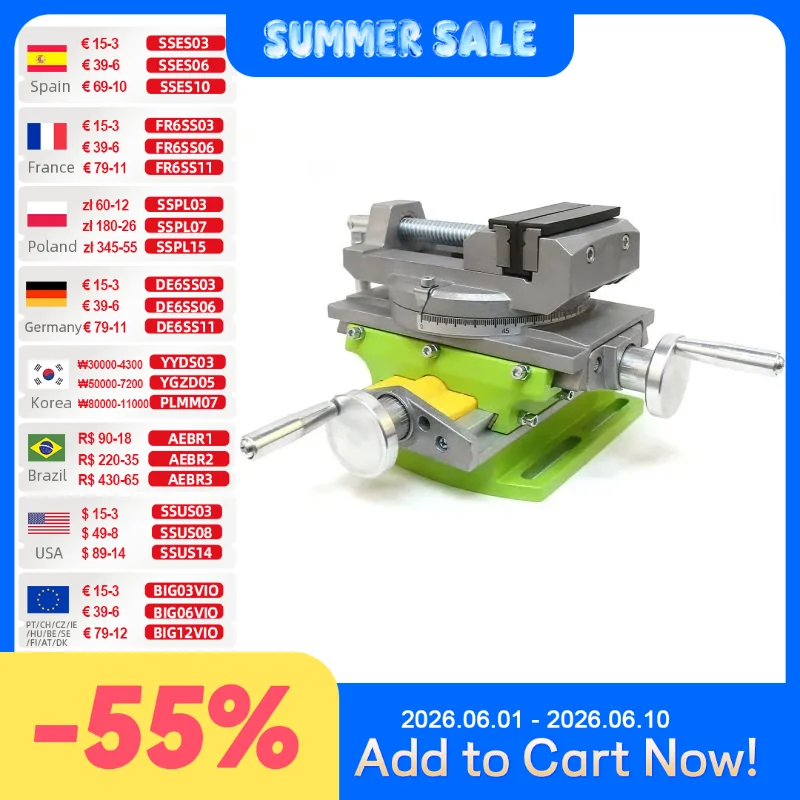
The ALLSOME 2-in-1 Milling Drilling Precision Vise is a versatile compound worktable designed for hobbyists and small workshop users seeking enhanced precision and repeatability in their drilling and milling operations. This benchtop accessory effectively transforms a standard drill press or even a handheld router into a more capable, controlled machining station, allowing for intricate and consistent work that would be challenging to achieve freehand. Its dual functionality as both a precision vise and a swiveling compound table addresses common limitations faced by DIY enthusiasts and model makers.
The visible construction of this compound worktable primarily utilizes aluminum alloy for the main body and base, complemented by steel components for the lead screws, handles, and vise jaws. This material selection is a deliberate choice. Aluminum alloy offers a beneficial balance of strength and weight, making the unit robust enough for light to medium-duty tasks without being overly cumbersome to reposition on a workbench. Its inherent corrosion resistance also contributes to the longevity of the tool in varied workshop environments.
This combination of materials aims to provide sufficient rigidity for accurate workpiece positioning and movement. The steel components, particularly in the lead screws and vise jaws, are crucial for resisting wear and maintaining clamping force over time. Unlike simpler cast iron vises that can be excessively heavy and prone to surface rust, the aluminum alloy construction offers a more manageable weight for setup and breakdown, while still providing a stable platform for workpieces. This lighter design is particularly advantageous for users who may need to frequently move the vise between different machines or storage locations.
Compared to basic drill press vises, which often lack any form of X-Y axis movement, this unit offers a significant upgrade. The use of aluminum for the main frame helps in dampening some vibrations, which is beneficial for achieving cleaner cuts and drilled holes. It's a practical choice for a tool intended for precision work where excessive weight might hinder portability rather than enhance stability for its intended scale of operation.
Central to the ALLSOME vise's appeal is its ability to provide two-axis (X-Y) movement along with a swivel base. The X-Y axes are controlled by independent lead screws, each equipped with a handwheel for fine adjustments. This allows for precise incremental movements of the workpiece, essential for operations like slotting, drilling multiple holes in a precise pattern, or performing light milling passes. The visible scales on the lead screw collars indicate that users can make controlled adjustments, though the exact resolution (e.g., turns per inch/mm) is not explicitly detailed in the visuals.
This compound movement capability directly addresses the need for repeatable cuts and accurate hole placement. Imagine a scenario where a series of parallel grooves needs to be milled into a piece of wood or plastic. With a standard vise, this would require repositioning the workpiece multiple times, leading to potential inaccuracies. This tool, however, allows the user to simply adjust the X-axis for the next pass, ensuring consistent spacing and depth. It provides a level of control that significantly enhances the quality of finished projects.
Unlike traditional drill press tables that offer only vertical (Z-axis) movement, or basic vises that merely clamp, this compound worktable introduces a new dimension of control. This makes it an invaluable asset for tasks such as creating mortise and tenon joints with a router, engraving patterns, or accurately drilling bolt hole circles. The ability to precisely move the workpiece rather than the tool itself simplifies complex machining operations, making them accessible to users without dedicated milling machines.
The swivel base is another key feature, allowing the entire vise and compound table assembly to rotate up to 90 degrees. This rotation is facilitated by loosening screws, as indicated in the product imagery, enabling the user to change the orientation of the workpiece without unclamping it. This is particularly useful for angular drilling, machining workpieces at specific angles, or simply reorienting the work for better access during an operation.
This rotational capability adds a layer of versatility, allowing for more complex geometries to be tackled. For instance, if a project requires drilling holes at a 45-degree angle relative to an existing feature, the user can easily rotate the entire setup to the desired angle, secure it, and proceed with drilling. This eliminates the need for complex clamping jigs or repeated re-clamping, saving both time and reducing the risk of error.
Compared to fixed-base vises, the swivel function significantly expands the range of projects that can be undertaken. It's especially beneficial for custom fabrication or repair work where non-orthogonal cuts and holes are common. The visual representation shows clear markings for angle measurement, suggesting that precise angular adjustments are achievable, further enhancing its utility for detailed work.
One of the most compelling aspects of this tool is its potential to turn a handheld router into a table-mounted precision tool. By securely clamping the workpiece in the vise and using the X-Y movement, a user can guide the workpiece under a fixed router bit (assuming a suitable mounting solution for the router itself, not included with the vise). This setup mimics the functionality of a small router table with a sliding fence, but with the added precision of lead screw adjustments.
This capability is a game-changer for hobbyists who might not have the space or budget for a full-sized router table or a dedicated milling machine. It allows for highly controlled routing operations, such as cutting dadoes, rabbets, or decorative edges with consistent results. The ability to make precise, repeatable passes ensures that each cut is identical, which is crucial for joinery or intricate designs.
In contrast to freehand routing, which relies heavily on user skill and often results in inconsistencies, using this compound worktable provides mechanical guidance. This significantly reduces the learning curve for complex routing tasks and allows even novice users to achieve professional-looking results. It's an economical way to expand the capabilities of existing power tools, maximizing their utility and value.
The vise itself features hardened steel jaws that appear to offer a secure grip on various materials. The jaws are equipped with protective pads, likely made of a softer material like rubber or plastic, to prevent marring delicate workpieces. The design suggests a robust clamping mechanism, essential for preventing workpiece movement during drilling or milling operations. A stable workpiece is paramount for both safety and precision.
Effective clamping is fundamental to any machining operation. Loose workpieces can lead to inaccurate cuts, damaged tools, and potential injury. The visible lead screw mechanism for the vise jaw ensures strong, even pressure distribution across the workpiece. This design is superior to quick-release mechanisms for precision work where absolute immobility is required.
Unlike many general-purpose vises, the integration of the vise directly into the compound table ensures that the clamping force is applied in perfect alignment with the movement axes. This integrated design minimizes any potential for deflection or misalignment that could occur if a separate vise were simply clamped onto a standard compound table. The result is a more stable and accurate setup for all operations.
The design emphasizes ease of use, with clearly visible handwheels and scales. The ability to loosen screws for rotation, as highlighted in one of the images, indicates a straightforward mechanism for adjusting the swivel base. The overall form factor appears compact, making it suitable for smaller workshops or for users with limited bench space. Its relatively light weight for its functionality also contributes to an easier setup and storage experience.
For users engaged in repetitive tasks, such as drilling a series of holes for a pegboard or creating identical components for a model, the precision and repeatability offered by this worktable are invaluable. It removes much of the guesswork and manual measurement, allowing for faster and more accurate production. This efficiency translates directly into time saved and a higher quality output.
Compared to attempting similar tasks with only a drill press and a standard fence, this compound worktable provides a far greater degree of control and flexibility. It bridges the gap between basic workshop tools and more specialized, expensive machinery, offering a cost-effective solution for expanding a hobbyist's capabilities. The investment in such a tool quickly pays dividends in terms of improved project quality and reduced frustration.
This ALLSOME vise and compound worktable empowers users to tackle projects with a level of precision previously reserved for larger, more expensive equipment. Imagine effortlessly cutting perfectly parallel slots in a custom enclosure, or drilling a matrix of holes with absolute consistency for a scientific prototype. This tool provides the mechanical advantage needed to transform ambitious ideas into tangible, high-quality finished products, enhancing both the joy of creation and the pride in a job well done.
Structural Integrity and Material Choices
The visible construction of this compound worktable primarily utilizes aluminum alloy for the main body and base, complemented by steel components for the lead screws, handles, and vise jaws. This material selection is a deliberate choice. Aluminum alloy offers a beneficial balance of strength and weight, making the unit robust enough for light to medium-duty tasks without being overly cumbersome to reposition on a workbench. Its inherent corrosion resistance also contributes to the longevity of the tool in varied workshop environments.
This combination of materials aims to provide sufficient rigidity for accurate workpiece positioning and movement. The steel components, particularly in the lead screws and vise jaws, are crucial for resisting wear and maintaining clamping force over time. Unlike simpler cast iron vises that can be excessively heavy and prone to surface rust, the aluminum alloy construction offers a more manageable weight for setup and breakdown, while still providing a stable platform for workpieces. This lighter design is particularly advantageous for users who may need to frequently move the vise between different machines or storage locations.
Compared to basic drill press vises, which often lack any form of X-Y axis movement, this unit offers a significant upgrade. The use of aluminum for the main frame helps in dampening some vibrations, which is beneficial for achieving cleaner cuts and drilled holes. It's a practical choice for a tool intended for precision work where excessive weight might hinder portability rather than enhance stability for its intended scale of operation.
Precision Machining Capabilities
Central to the ALLSOME vise's appeal is its ability to provide two-axis (X-Y) movement along with a swivel base. The X-Y axes are controlled by independent lead screws, each equipped with a handwheel for fine adjustments. This allows for precise incremental movements of the workpiece, essential for operations like slotting, drilling multiple holes in a precise pattern, or performing light milling passes. The visible scales on the lead screw collars indicate that users can make controlled adjustments, though the exact resolution (e.g., turns per inch/mm) is not explicitly detailed in the visuals.
This compound movement capability directly addresses the need for repeatable cuts and accurate hole placement. Imagine a scenario where a series of parallel grooves needs to be milled into a piece of wood or plastic. With a standard vise, this would require repositioning the workpiece multiple times, leading to potential inaccuracies. This tool, however, allows the user to simply adjust the X-axis for the next pass, ensuring consistent spacing and depth. It provides a level of control that significantly enhances the quality of finished projects.
Unlike traditional drill press tables that offer only vertical (Z-axis) movement, or basic vises that merely clamp, this compound worktable introduces a new dimension of control. This makes it an invaluable asset for tasks such as creating mortise and tenon joints with a router, engraving patterns, or accurately drilling bolt hole circles. The ability to precisely move the workpiece rather than the tool itself simplifies complex machining operations, making them accessible to users without dedicated milling machines.
Rotational Flexibility
The swivel base is another key feature, allowing the entire vise and compound table assembly to rotate up to 90 degrees. This rotation is facilitated by loosening screws, as indicated in the product imagery, enabling the user to change the orientation of the workpiece without unclamping it. This is particularly useful for angular drilling, machining workpieces at specific angles, or simply reorienting the work for better access during an operation.
This rotational capability adds a layer of versatility, allowing for more complex geometries to be tackled. For instance, if a project requires drilling holes at a 45-degree angle relative to an existing feature, the user can easily rotate the entire setup to the desired angle, secure it, and proceed with drilling. This eliminates the need for complex clamping jigs or repeated re-clamping, saving both time and reducing the risk of error.
Compared to fixed-base vises, the swivel function significantly expands the range of projects that can be undertaken. It's especially beneficial for custom fabrication or repair work where non-orthogonal cuts and holes are common. The visual representation shows clear markings for angle measurement, suggesting that precise angular adjustments are achievable, further enhancing its utility for detailed work.
Enhancing Workshop Efficiency
One of the most compelling aspects of this tool is its potential to turn a handheld router into a table-mounted precision tool. By securely clamping the workpiece in the vise and using the X-Y movement, a user can guide the workpiece under a fixed router bit (assuming a suitable mounting solution for the router itself, not included with the vise). This setup mimics the functionality of a small router table with a sliding fence, but with the added precision of lead screw adjustments.
This capability is a game-changer for hobbyists who might not have the space or budget for a full-sized router table or a dedicated milling machine. It allows for highly controlled routing operations, such as cutting dadoes, rabbets, or decorative edges with consistent results. The ability to make precise, repeatable passes ensures that each cut is identical, which is crucial for joinery or intricate designs.
In contrast to freehand routing, which relies heavily on user skill and often results in inconsistencies, using this compound worktable provides mechanical guidance. This significantly reduces the learning curve for complex routing tasks and allows even novice users to achieve professional-looking results. It's an economical way to expand the capabilities of existing power tools, maximizing their utility and value.
Workpiece Clamping and Stability
The vise itself features hardened steel jaws that appear to offer a secure grip on various materials. The jaws are equipped with protective pads, likely made of a softer material like rubber or plastic, to prevent marring delicate workpieces. The design suggests a robust clamping mechanism, essential for preventing workpiece movement during drilling or milling operations. A stable workpiece is paramount for both safety and precision.
Effective clamping is fundamental to any machining operation. Loose workpieces can lead to inaccurate cuts, damaged tools, and potential injury. The visible lead screw mechanism for the vise jaw ensures strong, even pressure distribution across the workpiece. This design is superior to quick-release mechanisms for precision work where absolute immobility is required.
Unlike many general-purpose vises, the integration of the vise directly into the compound table ensures that the clamping force is applied in perfect alignment with the movement axes. This integrated design minimizes any potential for deflection or misalignment that could occur if a separate vise were simply clamped onto a standard compound table. The result is a more stable and accurate setup for all operations.
User Experience and Practical Application
The design emphasizes ease of use, with clearly visible handwheels and scales. The ability to loosen screws for rotation, as highlighted in one of the images, indicates a straightforward mechanism for adjusting the swivel base. The overall form factor appears compact, making it suitable for smaller workshops or for users with limited bench space. Its relatively light weight for its functionality also contributes to an easier setup and storage experience.
For users engaged in repetitive tasks, such as drilling a series of holes for a pegboard or creating identical components for a model, the precision and repeatability offered by this worktable are invaluable. It removes much of the guesswork and manual measurement, allowing for faster and more accurate production. This efficiency translates directly into time saved and a higher quality output.
Compared to attempting similar tasks with only a drill press and a standard fence, this compound worktable provides a far greater degree of control and flexibility. It bridges the gap between basic workshop tools and more specialized, expensive machinery, offering a cost-effective solution for expanding a hobbyist's capabilities. The investment in such a tool quickly pays dividends in terms of improved project quality and reduced frustration.
This ALLSOME vise and compound worktable empowers users to tackle projects with a level of precision previously reserved for larger, more expensive equipment. Imagine effortlessly cutting perfectly parallel slots in a custom enclosure, or drilling a matrix of holes with absolute consistency for a scientific prototype. This tool provides the mechanical advantage needed to transform ambitious ideas into tangible, high-quality finished products, enhancing both the joy of creation and the pride in a job well done.