Adjustable AC Overcurrent Protection Relay Module
Official Store Deal
Expert Analysis Overview
The Adjustable AC Overcurrent Protection Relay Module is a critical safeguarding component designed for engineers and hobbyists requiring precise current monitoring and circuit isolation. This compact board integrates a current transformer and a robust relay, offering an essential layer of defense against potentially damaging overcurrent events in AC circuits. Its adjustable threshold allows for tailored protection, making it a versatile tool in various electronic applications.
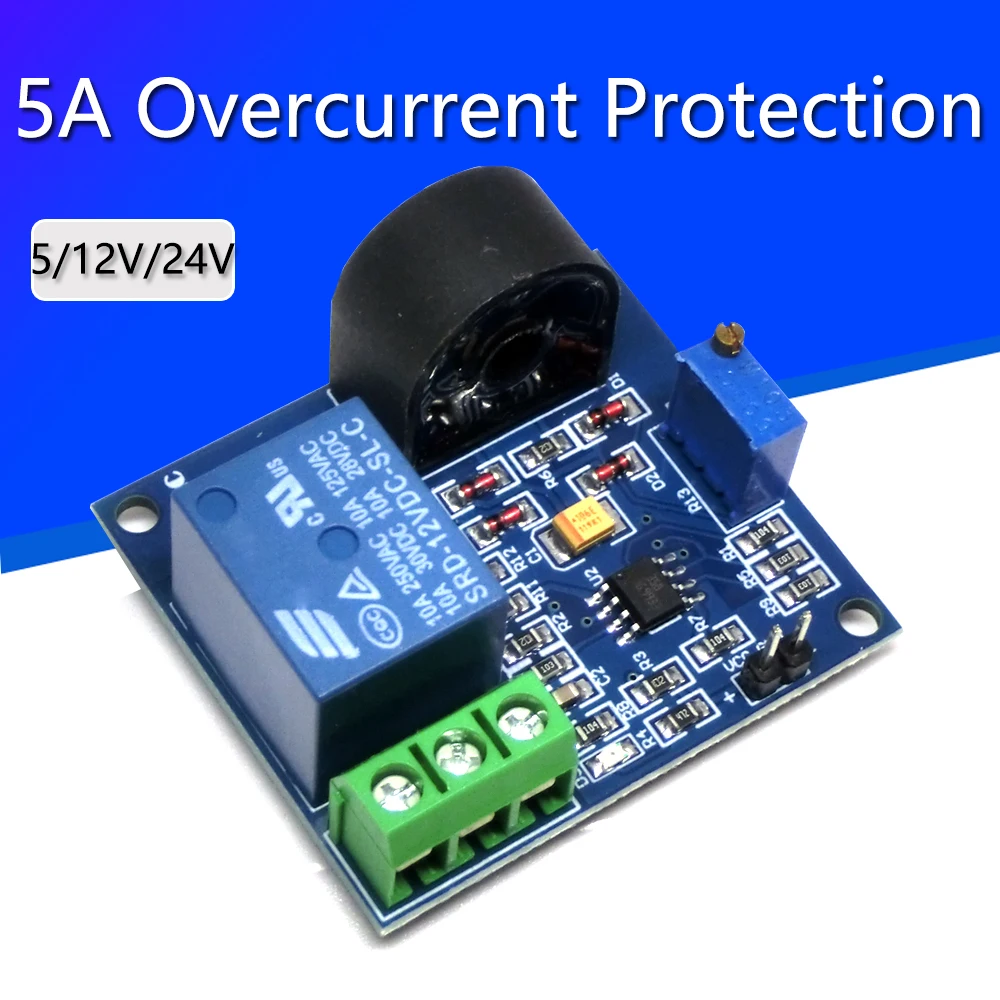
The module's primary current sensing is handled by the ZMCT103C current transformer. This toroidal component is visible as the black ring on the blue PCB. It provides non-invasive AC current measurement.
This transformer converts the AC current flowing through a conductor into a proportional, isolated voltage signal. This is crucial for safely monitoring high-current lines without direct electrical contact. The signal is then fed into the module's control circuitry.
Compared to shunt resistors, which introduce resistance and power loss into the main circuit, the ZMCT103C offers superior isolation and minimal impact on the monitored line. It is a common choice for accurate, isolated AC current sensing.
The ZMCT103C operates on the principle of electromagnetic induction. As AC current passes through its core, it generates a magnetic field. This field induces a proportional current in the transformer's secondary coil.
This induced current is then conditioned and rectified by the onboard circuitry. The resulting DC voltage is proportional to the AC current being measured. This allows for a clean signal.
Unlike simpler current detection methods that might rely on voltage drops, this inductive approach provides inherent electrical isolation. This isolation protects the control circuitry from the high voltage of the monitored load. It also ensures safety.
The conditioned signal from the current transformer is fed into a comparator circuit. This circuit compares the measured current's voltage equivalent against a user-defined reference voltage. This reference voltage is set via the onboard potentiometer.
When the measured current's voltage exceeds the set reference, the comparator triggers. This action signals an overcurrent condition. The response is swift.
This precise thresholding mechanism allows users to define exactly at what current level the protection should activate. Without this adjustability, the module would be far less adaptable to different circuit requirements. It offers flexibility.
A prominent feature of the module is the SRD-12VDC-SL-C relay. This blue, cube-shaped component is clearly visible. It acts as the switching element.
Upon detection of an overcurrent condition, the control circuitry energizes this relay. The relay's contacts then switch, typically opening a normally closed circuit or closing a normally open one. This isolates the protected load.
This type of relay is a standard component in many control applications, known for its reliability and ability to handle significant power. It provides a physical break in the circuit. This is a crucial safety feature.
The SRD-12VDC-SL-C relay boasts contact ratings of 10A at 250VAC and 10A at 30VDC. These ratings indicate the maximum current and voltage the relay contacts can safely switch. This is a substantial capacity.
These ratings mean the module can effectively control a wide range of AC loads, such as small motors, lighting circuits, or heating elements, provided their current draw does not exceed 10A. It handles moderate power. For DC applications, it can manage loads up to 30V and 10A.
Compared to smaller signal relays, this component offers robust switching capabilities. It ensures that the protective action can handle the actual power demands of many common electronic and electrical systems. It prevents contact welding.
The relay provides galvanic isolation between the control circuit and the load circuit. This means there is no direct electrical connection between the low-voltage control side and the potentially high-voltage load side. This is vital for safety.
This isolation protects sensitive control electronics, such as microcontrollers, from voltage spikes or faults on the load side. It also prevents dangerous voltages from propagating back to the user interface. Safety is paramount.
Unlike simple fuse protection, which is a one-time event, a relay-based system can be reset and re-engaged, offering a more dynamic and reusable protection mechanism. It offers a recoverable fault state.
The module is designed for multi-voltage compatibility, supporting 5V, 12V, or 24V DC power supplies. This adaptability is indicated by the text overlay in the first image. It offers broad utility.
This wide operating voltage range makes the module suitable for integration into various existing electronic systems. Whether powered by a standard USB supply, a car battery, or an industrial control voltage, it can adapt. This reduces complexity for users.
Many similar modules are often limited to a single supply voltage, requiring additional voltage regulators or specific power sources. This module's flexibility simplifies system design and component sourcing. It is highly adaptable.
The specific variant of the module determines its operating voltage. Users must select the appropriate version for their application. The 12V variant is common.
This design choice allows the manufacturer to optimize components for efficiency and reliability at specific voltages. It ensures stable operation. The power input is typically via a two-pin header or screw terminal.
This approach contrasts with modules that use wide-range regulators, which can sometimes introduce more heat or be less efficient at certain voltages. Dedicated voltage variants often perform better. They are optimized.
The module features screw terminal blocks for both power input and load connections. A green terminal block is visible, typically for the load. A blue one might be for power or signal.
Screw terminals provide a secure and reliable method for connecting wires. They are particularly useful in applications where vibrations might loosen other types of connectors. Connections are firm.
Unlike soldered connections, which are permanent, or header pins, which can be prone to accidental disconnections, screw terminals allow for easy installation, modification, and maintenance. They are user-friendly. This enhances serviceability.
The reliability of this module hinges on its well-integrated components and the ability to fine-tune its operation. The visible potentiometer is key to this. It offers control.
The control IC, likely a comparator or op-amp, works in conjunction with the ZMCT103C and the potentiometer to ensure consistent and accurate current detection. Its function is critical. This ensures consistent performance.
Such integrated solutions are generally more reliable than discrete component designs, as they reduce component count and potential points of failure. The design is streamlined. This contributes to longevity.
An adjustable potentiometer is clearly visible on the PCB. This component allows the user to precisely set the overcurrent trip point. Adjustments are simple.
To calibrate, a known AC current is typically passed through the current transformer, and the potentiometer is turned until the relay triggers at the desired threshold. This method ensures accuracy. It allows for fine-tuning.
This manual adjustment capability is a significant advantage over fixed-threshold protection devices. It allows the module to be adapted to a wide array of specific circuit requirements and sensitivities. It provides customization.
The module includes a status indicator LED. This small light provides visual feedback on the module's operational state. It is a simple, effective feature.
When the module detects an overcurrent condition and the relay is activated, this LED typically illuminates. This provides immediate visual confirmation of a trip event. Users get instant feedback.
This visual cue is invaluable for troubleshooting and monitoring, allowing users to quickly ascertain if the protection mechanism has engaged without needing additional test equipment. It simplifies diagnostics.
The visible blue PCB appears to be of standard FR-4 construction. The components are surface-mounted (SMD) and through-hole. This is a common manufacturing approach.
The layout appears logical, with sufficient spacing between high-current and low-current sections where possible. This minimizes interference. The board is well-populated.
Compared to older, hand-wired prototypes, a professionally manufactured PCB offers superior electrical characteristics and mechanical stability. It is a reliable foundation. This ensures consistent performance.
The solder joints visible on the through-hole components, such as the relay and terminal blocks, appear clean and well-formed. Good solder joints are critical for long-term reliability. They ensure robust connections.
Surface-mount components are precisely placed, indicating automated assembly processes. This precision reduces manufacturing defects. Component alignment is consistent.
Poor soldering can lead to intermittent connections, increased resistance, and premature component failure. The visible quality suggests a reasonable level of manufacturing care. It implies durability.
Close inspection of the images reveals generally clean solder pads and minimal flux residue. This indicates a controlled soldering process. Cleanliness is important.
Reliable solder joints are fundamental to the module's long-term performance, especially for components like the relay that experience mechanical stress during switching. They prevent failures. A strong connection is vital.
Unlike modules with visible cold joints or excessive solder blobs, which can indicate rushed or low-quality manufacturing, this module's visible soldering appears competent. It suggests attention to detail.
This module represents a cost-effective solution for protecting more expensive equipment. Its low price point makes it an accessible upgrade for many projects. It saves money.
By preventing overcurrent damage, the module extends the lifespan of connected devices and reduces the need for costly repairs or replacements. This is a significant return on investment. It protects assets.
Instead of relying solely on fuses, which require manual replacement after each trip, this relay module offers a resettable and adjustable protection system. It is a reusable solution.
Investing a small amount in this protection module can prevent much larger expenses down the line. A damaged power supply or motor can be very costly. Prevention is cheaper.
For hobbyists and small-scale industrial applications, this module provides professional-grade protection without the associated high cost of integrated industrial protection systems. It democratizes safety. It is affordable.
This approach aligns with the principle of fixing expensive equipment with affordable components. It ensures that critical systems remain operational longer. It enhances system resilience.
Consider a scenario where a motor might occasionally draw excessive current due to a mechanical jam. This module could detect the surge and cut power, preventing motor burnout. It safeguards machinery.
In home automation, it could protect sensitive lighting circuits from faulty appliances. It adds a layer of security. This prevents electrical hazards.
This module is an ideal component for DIY power supplies, industrial control panels, and embedded systems where precise AC current monitoring and protection are necessary. It has broad utility. It is a versatile tool.
Imagine the peace of mind knowing that your valuable electronics are shielded from unexpected current surges. This module stands as a silent guardian, constantly vigilant, ready to isolate your circuits the moment a threat emerges. It ensures the longevity and stable operation of your projects, allowing you to focus on innovation rather than worrying about component failure. This small investment provides significant protection, securing your electrical endeavors against the unforeseen. It keeps your systems running smoothly, day in and day out.
Precision Current Monitoring: The ZMCT103C Core
The module's primary current sensing is handled by the ZMCT103C current transformer. This toroidal component is visible as the black ring on the blue PCB. It provides non-invasive AC current measurement.
This transformer converts the AC current flowing through a conductor into a proportional, isolated voltage signal. This is crucial for safely monitoring high-current lines without direct electrical contact. The signal is then fed into the module's control circuitry.
Compared to shunt resistors, which introduce resistance and power loss into the main circuit, the ZMCT103C offers superior isolation and minimal impact on the monitored line. It is a common choice for accurate, isolated AC current sensing.
Sensing Dynamics
The ZMCT103C operates on the principle of electromagnetic induction. As AC current passes through its core, it generates a magnetic field. This field induces a proportional current in the transformer's secondary coil.
This induced current is then conditioned and rectified by the onboard circuitry. The resulting DC voltage is proportional to the AC current being measured. This allows for a clean signal.
Unlike simpler current detection methods that might rely on voltage drops, this inductive approach provides inherent electrical isolation. This isolation protects the control circuitry from the high voltage of the monitored load. It also ensures safety.
Signal Conversion and Thresholding
The conditioned signal from the current transformer is fed into a comparator circuit. This circuit compares the measured current's voltage equivalent against a user-defined reference voltage. This reference voltage is set via the onboard potentiometer.
When the measured current's voltage exceeds the set reference, the comparator triggers. This action signals an overcurrent condition. The response is swift.
This precise thresholding mechanism allows users to define exactly at what current level the protection should activate. Without this adjustability, the module would be far less adaptable to different circuit requirements. It offers flexibility.
Robust Switching: The Integrated Relay
A prominent feature of the module is the SRD-12VDC-SL-C relay. This blue, cube-shaped component is clearly visible. It acts as the switching element.
Upon detection of an overcurrent condition, the control circuitry energizes this relay. The relay's contacts then switch, typically opening a normally closed circuit or closing a normally open one. This isolates the protected load.
This type of relay is a standard component in many control applications, known for its reliability and ability to handle significant power. It provides a physical break in the circuit. This is a crucial safety feature.
Contact Ratings and Load Management
The SRD-12VDC-SL-C relay boasts contact ratings of 10A at 250VAC and 10A at 30VDC. These ratings indicate the maximum current and voltage the relay contacts can safely switch. This is a substantial capacity.
These ratings mean the module can effectively control a wide range of AC loads, such as small motors, lighting circuits, or heating elements, provided their current draw does not exceed 10A. It handles moderate power. For DC applications, it can manage loads up to 30V and 10A.
Compared to smaller signal relays, this component offers robust switching capabilities. It ensures that the protective action can handle the actual power demands of many common electronic and electrical systems. It prevents contact welding.
Isolation and Safety Protocols
The relay provides galvanic isolation between the control circuit and the load circuit. This means there is no direct electrical connection between the low-voltage control side and the potentially high-voltage load side. This is vital for safety.
This isolation protects sensitive control electronics, such as microcontrollers, from voltage spikes or faults on the load side. It also prevents dangerous voltages from propagating back to the user interface. Safety is paramount.
Unlike simple fuse protection, which is a one-time event, a relay-based system can be reset and re-engaged, offering a more dynamic and reusable protection mechanism. It offers a recoverable fault state.
Versatile Power Integration
The module is designed for multi-voltage compatibility, supporting 5V, 12V, or 24V DC power supplies. This adaptability is indicated by the text overlay in the first image. It offers broad utility.
This wide operating voltage range makes the module suitable for integration into various existing electronic systems. Whether powered by a standard USB supply, a car battery, or an industrial control voltage, it can adapt. This reduces complexity for users.
Many similar modules are often limited to a single supply voltage, requiring additional voltage regulators or specific power sources. This module's flexibility simplifies system design and component sourcing. It is highly adaptable.
Multi-Voltage Compatibility
The specific variant of the module determines its operating voltage. Users must select the appropriate version for their application. The 12V variant is common.
This design choice allows the manufacturer to optimize components for efficiency and reliability at specific voltages. It ensures stable operation. The power input is typically via a two-pin header or screw terminal.
This approach contrasts with modules that use wide-range regulators, which can sometimes introduce more heat or be less efficient at certain voltages. Dedicated voltage variants often perform better. They are optimized.
Input and Output Terminals
The module features screw terminal blocks for both power input and load connections. A green terminal block is visible, typically for the load. A blue one might be for power or signal.
Screw terminals provide a secure and reliable method for connecting wires. They are particularly useful in applications where vibrations might loosen other types of connectors. Connections are firm.
Unlike soldered connections, which are permanent, or header pins, which can be prone to accidental disconnections, screw terminals allow for easy installation, modification, and maintenance. They are user-friendly. This enhances serviceability.
Operational Reliability and Adjustment
The reliability of this module hinges on its well-integrated components and the ability to fine-tune its operation. The visible potentiometer is key to this. It offers control.
The control IC, likely a comparator or op-amp, works in conjunction with the ZMCT103C and the potentiometer to ensure consistent and accurate current detection. Its function is critical. This ensures consistent performance.
Such integrated solutions are generally more reliable than discrete component designs, as they reduce component count and potential points of failure. The design is streamlined. This contributes to longevity.
Threshold Calibration
An adjustable potentiometer is clearly visible on the PCB. This component allows the user to precisely set the overcurrent trip point. Adjustments are simple.
To calibrate, a known AC current is typically passed through the current transformer, and the potentiometer is turned until the relay triggers at the desired threshold. This method ensures accuracy. It allows for fine-tuning.
This manual adjustment capability is a significant advantage over fixed-threshold protection devices. It allows the module to be adapted to a wide array of specific circuit requirements and sensitivities. It provides customization.
Indicator Feedback
The module includes a status indicator LED. This small light provides visual feedback on the module's operational state. It is a simple, effective feature.
When the module detects an overcurrent condition and the relay is activated, this LED typically illuminates. This provides immediate visual confirmation of a trip event. Users get instant feedback.
This visual cue is invaluable for troubleshooting and monitoring, allowing users to quickly ascertain if the protection mechanism has engaged without needing additional test equipment. It simplifies diagnostics.
Durability and Assembly Quality
The visible blue PCB appears to be of standard FR-4 construction. The components are surface-mounted (SMD) and through-hole. This is a common manufacturing approach.
The layout appears logical, with sufficient spacing between high-current and low-current sections where possible. This minimizes interference. The board is well-populated.
Compared to older, hand-wired prototypes, a professionally manufactured PCB offers superior electrical characteristics and mechanical stability. It is a reliable foundation. This ensures consistent performance.
PCB Construction and Component Placement
The solder joints visible on the through-hole components, such as the relay and terminal blocks, appear clean and well-formed. Good solder joints are critical for long-term reliability. They ensure robust connections.
Surface-mount components are precisely placed, indicating automated assembly processes. This precision reduces manufacturing defects. Component alignment is consistent.
Poor soldering can lead to intermittent connections, increased resistance, and premature component failure. The visible quality suggests a reasonable level of manufacturing care. It implies durability.
Solder Joint Integrity
Close inspection of the images reveals generally clean solder pads and minimal flux residue. This indicates a controlled soldering process. Cleanliness is important.
Reliable solder joints are fundamental to the module's long-term performance, especially for components like the relay that experience mechanical stress during switching. They prevent failures. A strong connection is vital.
Unlike modules with visible cold joints or excessive solder blobs, which can indicate rushed or low-quality manufacturing, this module's visible soldering appears competent. It suggests attention to detail.
Strategic Value in Circuit Defense
This module represents a cost-effective solution for protecting more expensive equipment. Its low price point makes it an accessible upgrade for many projects. It saves money.
By preventing overcurrent damage, the module extends the lifespan of connected devices and reduces the need for costly repairs or replacements. This is a significant return on investment. It protects assets.
Instead of relying solely on fuses, which require manual replacement after each trip, this relay module offers a resettable and adjustable protection system. It is a reusable solution.
Cost-Effective Protection
Investing a small amount in this protection module can prevent much larger expenses down the line. A damaged power supply or motor can be very costly. Prevention is cheaper.
For hobbyists and small-scale industrial applications, this module provides professional-grade protection without the associated high cost of integrated industrial protection systems. It democratizes safety. It is affordable.
This approach aligns with the principle of fixing expensive equipment with affordable components. It ensures that critical systems remain operational longer. It enhances system resilience.
Application Scenarios
Consider a scenario where a motor might occasionally draw excessive current due to a mechanical jam. This module could detect the surge and cut power, preventing motor burnout. It safeguards machinery.
In home automation, it could protect sensitive lighting circuits from faulty appliances. It adds a layer of security. This prevents electrical hazards.
This module is an ideal component for DIY power supplies, industrial control panels, and embedded systems where precise AC current monitoring and protection are necessary. It has broad utility. It is a versatile tool.
Imagine the peace of mind knowing that your valuable electronics are shielded from unexpected current surges. This module stands as a silent guardian, constantly vigilant, ready to isolate your circuits the moment a threat emerges. It ensures the longevity and stable operation of your projects, allowing you to focus on innovation rather than worrying about component failure. This small investment provides significant protection, securing your electrical endeavors against the unforeseen. It keeps your systems running smoothly, day in and day out.