Addressable WS2812 5050 RGB LED Modules for DIY Projects
Official Store Deal
Expert Analysis Overview
The WS2812 5050 RGB LED Modules are versatile, individually addressable lighting components designed for hobbyists and professionals building dynamic visual displays. These modules represent a significant upgrade from standard single-color LEDs, offering full-spectrum control and seamless integration into complex systems. For the solar energy hobbyist, these components offer an exciting pathway to create efficient, low-power visual indicators, aesthetic lighting, or even educational displays that can run directly from a 5V DC solar charge controller.
These LED modules are not merely lights; they are programmable pixels. Each 5050 RGB LED package contains a tiny WS2812B integrated driver, allowing for individual control over its color and brightness. This granular control is crucial for applications requiring precise visual feedback or intricate lighting effects, which is often a challenge with simpler LED setups. The integrated driver simplifies the wiring considerably, reducing the need for external components and making the overall system more compact and reliable.
Imagine a remote weather station powered by solar, using these LEDs to visually represent wind speed, temperature, or battery charge levels. The ability to display a spectrum of colors based on data inputs provides an intuitive interface, far more engaging than a simple on/off indicator. This level of dynamic feedback enhances the utility of any off-grid monitoring system.
Compared to basic common-anode or common-cathode RGB LEDs that require separate current-limiting resistors and multiple microcontroller pins, the WS2812B modules streamline the process. A single data line can control hundreds of these LEDs, drastically simplifying the circuit design and reducing component count. This efficiency in design translates directly into less power consumption for the control circuitry itself, a vital consideration in solar-powered applications.
At the core of these modules is the WS2812B LED, a smart control LED light source that integrates a control circuit and an RGB chip in a 5050 component package. This integration means each LED acts as its own intelligent pixel. The control circuit includes a data latch and a signal reshaping amplification drive circuit, ensuring signal integrity across long chains.
When a data signal is sent, each LED reads the first 24 bits of data, extracts its own color information, and then passes the remaining data down the line to the next LED. This cascade effect allows for sequential control from a single data pin on a microcontroller. The robust internal design ensures consistent performance even when powering large arrays. This is a crucial distinction.
Traditional RGB LEDs often suffer from color inconsistencies or voltage drops over distance, requiring complex wiring and calibration. The WS2812B architecture, however, maintains color accuracy and brightness across the entire chain, provided adequate power is supplied. This reliability is paramount for any project where visual consistency is key, from artistic installations to critical status indicators.
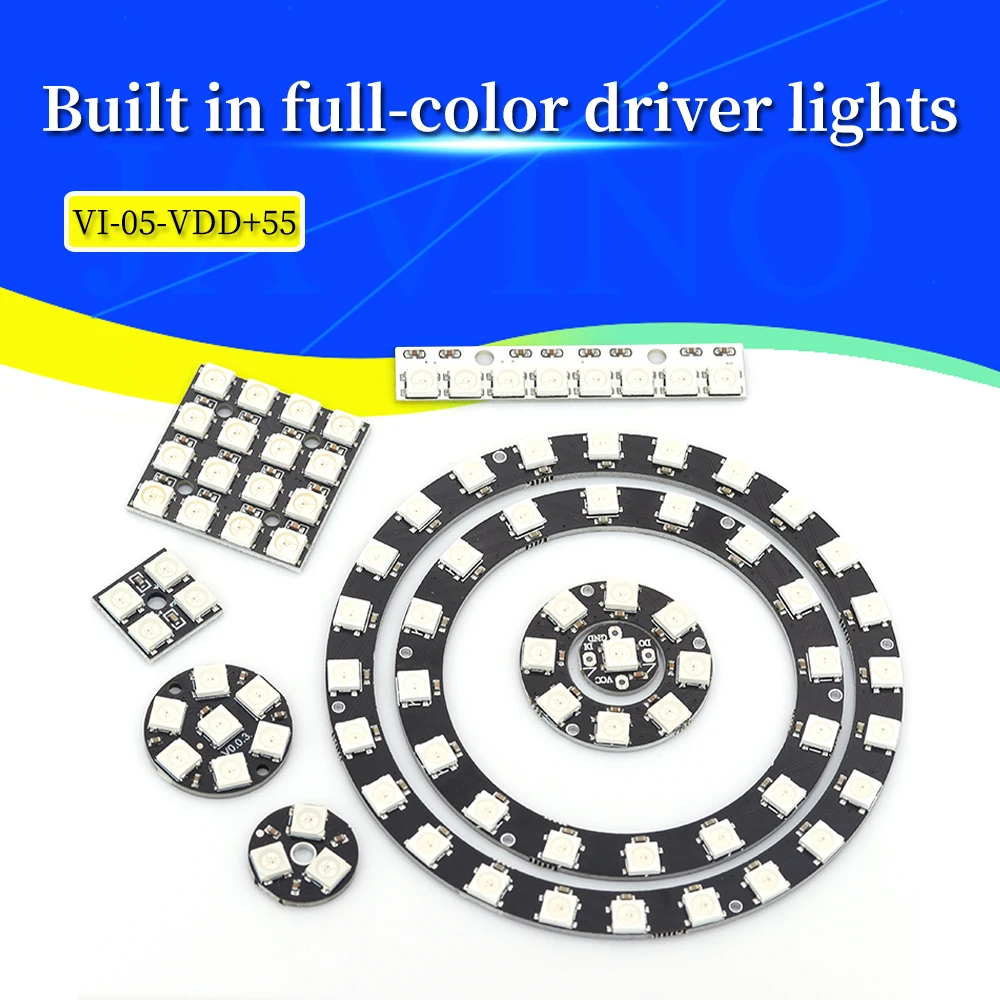
The product offers a variety of form factors: circular rings, square matrices, and linear strips. This modularity is a significant advantage for prototyping and custom installations. Whether designing a circular solar charge indicator, a square display panel, or a linear accent light, a suitable module is available. The images clearly show the different configurations, from small 4-LED squares to larger 64-LED matrices and various ring sizes.
Each module is designed for easy daisy-chaining. Small solder pads for data input (DI), data output (DO), 5V power, and ground are clearly marked. This allows for flexible expansion, connecting multiple rings, matrices, or strips together to form larger, more complex lighting systems. The physical layout of the PCBs appears clean, with good spacing for soldering.
Unlike rigid, pre-assembled LED panels that limit design freedom, these individual modules empower the creator. A designer can mix and match different shapes, arranging them into unique patterns or functional displays. This flexibility is invaluable for custom solar projects, where space and form factor can be highly specific. The small footprint of individual modules also allows for integration into tight enclosures.
These WS2812B LEDs operate on a 5V DC power supply, making them directly compatible with common microcontroller platforms like Arduino and ESP32, and crucially, with many solar power systems. A typical solar charge controller for small batteries often outputs 5V or 12V, with 5V being easily accessible via buck converters or direct USB outputs. Each LED draws approximately 20mA at full white brightness.
Calculating the total current draw is straightforward: multiply the number of LEDs by 20mA. For instance, a 64-LED matrix at full brightness would draw about 1.28 Amps (64 * 0.02A). This figure is manageable for many small solar setups, particularly if the LEDs are not constantly at full brightness or displaying white light. Color displays draw less current. Power management is simple.
Compared to high-voltage AC lighting systems, these 5V DC LEDs eliminate the need for inverters, reducing conversion losses and system complexity. This direct DC compatibility is a cornerstone for maximizing efficiency in off-grid solar applications. Every milliamp saved contributes to longer operation or smaller battery requirements, directly impacting the overall cost and sustainability of a solar project.
The modules are constructed on standard FR-4 PCB material, which provides a rigid and stable platform for the LEDs and integrated circuitry. The solder pads are tin-plated, ensuring good solderability and electrical contact. The overall build quality, as observed from the images, suggests a robust design suitable for hobbyist use and integration into custom enclosures. The components are well-aligned.
While the bare PCBs are not inherently waterproof, their solid-state nature means there are no moving parts to wear out. The lifespan of 5050 RGB LEDs is typically tens of thousands of hours, ensuring long-term reliability for most projects. For outdoor applications, conformal coating or a sealed enclosure would be necessary to protect against moisture and dust, a common practice in solar installations.
This construction contrasts with flexible LED strips, which, while offering different mounting options, can be more susceptible to physical damage or delamination over time if not properly supported. The rigid PCB design of these modules offers a more permanent and durable installation, particularly for fixed displays or internal components within a protective housing. They feel sturdy.
For the solar energy enthusiast, these WS2812B modules present an excellent opportunity to experiment with self-sustaining lighting and display systems. Their low voltage requirement aligns perfectly with direct output from many solar charge controllers or small battery banks. Imagine a solar-powered garden light that changes color based on ambient light levels or a portable solar charging station with a dynamic battery level indicator.
The efficiency of these LEDs, especially when displaying colors other than full white, means they can operate for extended periods on relatively small battery capacities. This makes them ideal for remote monitoring stations, camping lights, or decorative elements in an off-grid cabin. The capability to control each pixel individually allows for sophisticated power-saving modes, dimming specific sections or displaying only essential information to conserve energy.
Unlike conventional lighting that might require complex power conversion, these modules simplify the energy flow. This direct DC compatibility reduces system overhead and increases overall energy efficiency. The ease of programming with popular microcontrollers also means that sophisticated power management routines can be implemented, such as turning off LEDs during peak sunlight hours or dimming them at night to extend battery life.
At a price point of approximately $0.23 USD, these WS2812B LED modules offer exceptional value. This low cost makes them accessible for large-scale projects or for hobbyists on a budget, allowing for extensive experimentation without significant financial outlay. The value proposition is clear: high-functionality addressable RGB lighting at a fraction of the cost of pre-assembled smart lighting solutions.
Considering the integrated driver functionality, the cost per individually controllable pixel is remarkably low. This allows for the creation of intricate displays that would be prohibitively expensive using alternative methods. The economic viability of these modules encourages innovation and allows for the development of sophisticated solar-powered visual systems without compromising on budget.
This affordability also means that if a single LED fails (which is rare), replacing a module or even an individual LED is not a significant financial burden. This contrasts sharply with proprietary smart lighting systems where a single component failure might necessitate replacing an entire, expensive unit. The open-source nature of WS2812B control also means no ongoing software licensing costs, further enhancing long-term value.
Controlling these WS2812B LEDs is straightforward with popular microcontroller libraries such as Adafruit NeoPixel or FastLED. These libraries abstract away the complex timing requirements, allowing users to focus on creative lighting patterns. Basic programming involves initializing the LED strip, setting colors for individual pixels, and then showing the changes. This simplicity makes them ideal for beginners and experienced developers alike.
For solar energy applications, integrating these LEDs with environmental sensors (e.g., light sensors, temperature sensors) can create responsive, intelligent systems. A microcontroller can read sensor data and then dynamically adjust the LED display. This capability allows for real-time feedback on environmental conditions or system status, enhancing the functionality of any solar-powered device.
Unlike older addressable LED technologies that often required specific hardware interfaces or complex bit-banging routines, the WS2812B standard is widely supported across various microcontrollers. This broad compatibility ensures that users can leverage existing hardware and a vast community knowledge base for support and inspiration. The learning curve is gentle, but the creative potential is immense.
Picture your next solar-powered creation coming to life with vibrant, dynamic lighting. Imagine a smart greenhouse where these LEDs indicate soil moisture levels, or a portable solar charger that visually communicates its charging status with a flowing rainbow effect. These addressable RGB LED modules provide the capability to add a layer of interactive visual communication to any project, making complex data immediately understandable and engaging. The low power consumption ensures your creations remain efficient, extending battery life and maximizing the utility of your solar energy harvest. This is the future of interactive, eco-conscious design, powered by your ingenuity.
Precision Illumination for Off-Grid Projects
These LED modules are not merely lights; they are programmable pixels. Each 5050 RGB LED package contains a tiny WS2812B integrated driver, allowing for individual control over its color and brightness. This granular control is crucial for applications requiring precise visual feedback or intricate lighting effects, which is often a challenge with simpler LED setups. The integrated driver simplifies the wiring considerably, reducing the need for external components and making the overall system more compact and reliable.
Imagine a remote weather station powered by solar, using these LEDs to visually represent wind speed, temperature, or battery charge levels. The ability to display a spectrum of colors based on data inputs provides an intuitive interface, far more engaging than a simple on/off indicator. This level of dynamic feedback enhances the utility of any off-grid monitoring system.
Compared to basic common-anode or common-cathode RGB LEDs that require separate current-limiting resistors and multiple microcontroller pins, the WS2812B modules streamline the process. A single data line can control hundreds of these LEDs, drastically simplifying the circuit design and reducing component count. This efficiency in design translates directly into less power consumption for the control circuitry itself, a vital consideration in solar-powered applications.
The Heart of Dynamic Lighting: WS2812B Integration
At the core of these modules is the WS2812B LED, a smart control LED light source that integrates a control circuit and an RGB chip in a 5050 component package. This integration means each LED acts as its own intelligent pixel. The control circuit includes a data latch and a signal reshaping amplification drive circuit, ensuring signal integrity across long chains.
When a data signal is sent, each LED reads the first 24 bits of data, extracts its own color information, and then passes the remaining data down the line to the next LED. This cascade effect allows for sequential control from a single data pin on a microcontroller. The robust internal design ensures consistent performance even when powering large arrays. This is a crucial distinction.
Traditional RGB LEDs often suffer from color inconsistencies or voltage drops over distance, requiring complex wiring and calibration. The WS2812B architecture, however, maintains color accuracy and brightness across the entire chain, provided adequate power is supplied. This reliability is paramount for any project where visual consistency is key, from artistic installations to critical status indicators.
Building with Light: Modularity and Scalability
The product offers a variety of form factors: circular rings, square matrices, and linear strips. This modularity is a significant advantage for prototyping and custom installations. Whether designing a circular solar charge indicator, a square display panel, or a linear accent light, a suitable module is available. The images clearly show the different configurations, from small 4-LED squares to larger 64-LED matrices and various ring sizes.
Each module is designed for easy daisy-chaining. Small solder pads for data input (DI), data output (DO), 5V power, and ground are clearly marked. This allows for flexible expansion, connecting multiple rings, matrices, or strips together to form larger, more complex lighting systems. The physical layout of the PCBs appears clean, with good spacing for soldering.
Unlike rigid, pre-assembled LED panels that limit design freedom, these individual modules empower the creator. A designer can mix and match different shapes, arranging them into unique patterns or functional displays. This flexibility is invaluable for custom solar projects, where space and form factor can be highly specific. The small footprint of individual modules also allows for integration into tight enclosures.
Powering Your Vision: Efficiency in DC Systems
These WS2812B LEDs operate on a 5V DC power supply, making them directly compatible with common microcontroller platforms like Arduino and ESP32, and crucially, with many solar power systems. A typical solar charge controller for small batteries often outputs 5V or 12V, with 5V being easily accessible via buck converters or direct USB outputs. Each LED draws approximately 20mA at full white brightness.
Calculating the total current draw is straightforward: multiply the number of LEDs by 20mA. For instance, a 64-LED matrix at full brightness would draw about 1.28 Amps (64 * 0.02A). This figure is manageable for many small solar setups, particularly if the LEDs are not constantly at full brightness or displaying white light. Color displays draw less current. Power management is simple.
Compared to high-voltage AC lighting systems, these 5V DC LEDs eliminate the need for inverters, reducing conversion losses and system complexity. This direct DC compatibility is a cornerstone for maximizing efficiency in off-grid solar applications. Every milliamp saved contributes to longer operation or smaller battery requirements, directly impacting the overall cost and sustainability of a solar project.
Durability in the Field: Construction and Longevity
The modules are constructed on standard FR-4 PCB material, which provides a rigid and stable platform for the LEDs and integrated circuitry. The solder pads are tin-plated, ensuring good solderability and electrical contact. The overall build quality, as observed from the images, suggests a robust design suitable for hobbyist use and integration into custom enclosures. The components are well-aligned.
While the bare PCBs are not inherently waterproof, their solid-state nature means there are no moving parts to wear out. The lifespan of 5050 RGB LEDs is typically tens of thousands of hours, ensuring long-term reliability for most projects. For outdoor applications, conformal coating or a sealed enclosure would be necessary to protect against moisture and dust, a common practice in solar installations.
This construction contrasts with flexible LED strips, which, while offering different mounting options, can be more susceptible to physical damage or delamination over time if not properly supported. The rigid PCB design of these modules offers a more permanent and durable installation, particularly for fixed displays or internal components within a protective housing. They feel sturdy.
Beyond the Grid: Solar Integration Potential
For the solar energy enthusiast, these WS2812B modules present an excellent opportunity to experiment with self-sustaining lighting and display systems. Their low voltage requirement aligns perfectly with direct output from many solar charge controllers or small battery banks. Imagine a solar-powered garden light that changes color based on ambient light levels or a portable solar charging station with a dynamic battery level indicator.
The efficiency of these LEDs, especially when displaying colors other than full white, means they can operate for extended periods on relatively small battery capacities. This makes them ideal for remote monitoring stations, camping lights, or decorative elements in an off-grid cabin. The capability to control each pixel individually allows for sophisticated power-saving modes, dimming specific sections or displaying only essential information to conserve energy.
Unlike conventional lighting that might require complex power conversion, these modules simplify the energy flow. This direct DC compatibility reduces system overhead and increases overall energy efficiency. The ease of programming with popular microcontrollers also means that sophisticated power management routines can be implemented, such as turning off LEDs during peak sunlight hours or dimming them at night to extend battery life.
Cost-Effectiveness for the Eco-Conscious Maker
At a price point of approximately $0.23 USD, these WS2812B LED modules offer exceptional value. This low cost makes them accessible for large-scale projects or for hobbyists on a budget, allowing for extensive experimentation without significant financial outlay. The value proposition is clear: high-functionality addressable RGB lighting at a fraction of the cost of pre-assembled smart lighting solutions.
Considering the integrated driver functionality, the cost per individually controllable pixel is remarkably low. This allows for the creation of intricate displays that would be prohibitively expensive using alternative methods. The economic viability of these modules encourages innovation and allows for the development of sophisticated solar-powered visual systems without compromising on budget.
This affordability also means that if a single LED fails (which is rare), replacing a module or even an individual LED is not a significant financial burden. This contrasts sharply with proprietary smart lighting systems where a single component failure might necessitate replacing an entire, expensive unit. The open-source nature of WS2812B control also means no ongoing software licensing costs, further enhancing long-term value.
Seamless Implementation: Programming and Control
Controlling these WS2812B LEDs is straightforward with popular microcontroller libraries such as Adafruit NeoPixel or FastLED. These libraries abstract away the complex timing requirements, allowing users to focus on creative lighting patterns. Basic programming involves initializing the LED strip, setting colors for individual pixels, and then showing the changes. This simplicity makes them ideal for beginners and experienced developers alike.
For solar energy applications, integrating these LEDs with environmental sensors (e.g., light sensors, temperature sensors) can create responsive, intelligent systems. A microcontroller can read sensor data and then dynamically adjust the LED display. This capability allows for real-time feedback on environmental conditions or system status, enhancing the functionality of any solar-powered device.
Unlike older addressable LED technologies that often required specific hardware interfaces or complex bit-banging routines, the WS2812B standard is widely supported across various microcontrollers. This broad compatibility ensures that users can leverage existing hardware and a vast community knowledge base for support and inspiration. The learning curve is gentle, but the creative potential is immense.
Envisioning Your Next Renewable Project
Picture your next solar-powered creation coming to life with vibrant, dynamic lighting. Imagine a smart greenhouse where these LEDs indicate soil moisture levels, or a portable solar charger that visually communicates its charging status with a flowing rainbow effect. These addressable RGB LED modules provide the capability to add a layer of interactive visual communication to any project, making complex data immediately understandable and engaging. The low power consumption ensures your creations remain efficient, extending battery life and maximizing the utility of your solar energy harvest. This is the future of interactive, eco-conscious design, powered by your ingenuity.