3DSWAY Filament Dryer Box Connectors & PTFE Tube Kit
Official Store Deal
Expert Analysis Overview
Optimizing Filament Management for Superior 3D Prints
The 3DSWAY Filament Dryer Box Connectors & PTFE Tube Kit is a practical upgrade solution for 3D printing enthusiasts and educators focused on filament management. This kit addresses common issues related to filament degradation and feeding inconsistencies, particularly crucial for maintaining material integrity in educational or workshop environments. The components are designed to integrate seamlessly into DIY dry box setups. This improves print quality. It extends filament lifespan.
Unlike basic open-air filament storage, which leaves materials vulnerable to ambient humidity, this kit provides the essential components to create a controlled, sealed environment. The included PC4-M6 pneumatic connectors and PTFE tubing form a vital conduit. This ensures that filament travels from a protected space directly to the extruder with minimal exposure. This proactive approach prevents moisture absorption. It is a significant factor in print failures like stringing, bubbling, and weakened layers.
For STEM educators, teaching students about material science in 3D printing often involves discussing the impact of environmental factors. This kit offers a tangible example of how proper storage and feeding mechanisms directly influence print outcomes. It demonstrates engineering solutions to common problems. Students can observe the difference firsthand. This makes complex concepts accessible.
Connector Design and Evolutionary Improvements
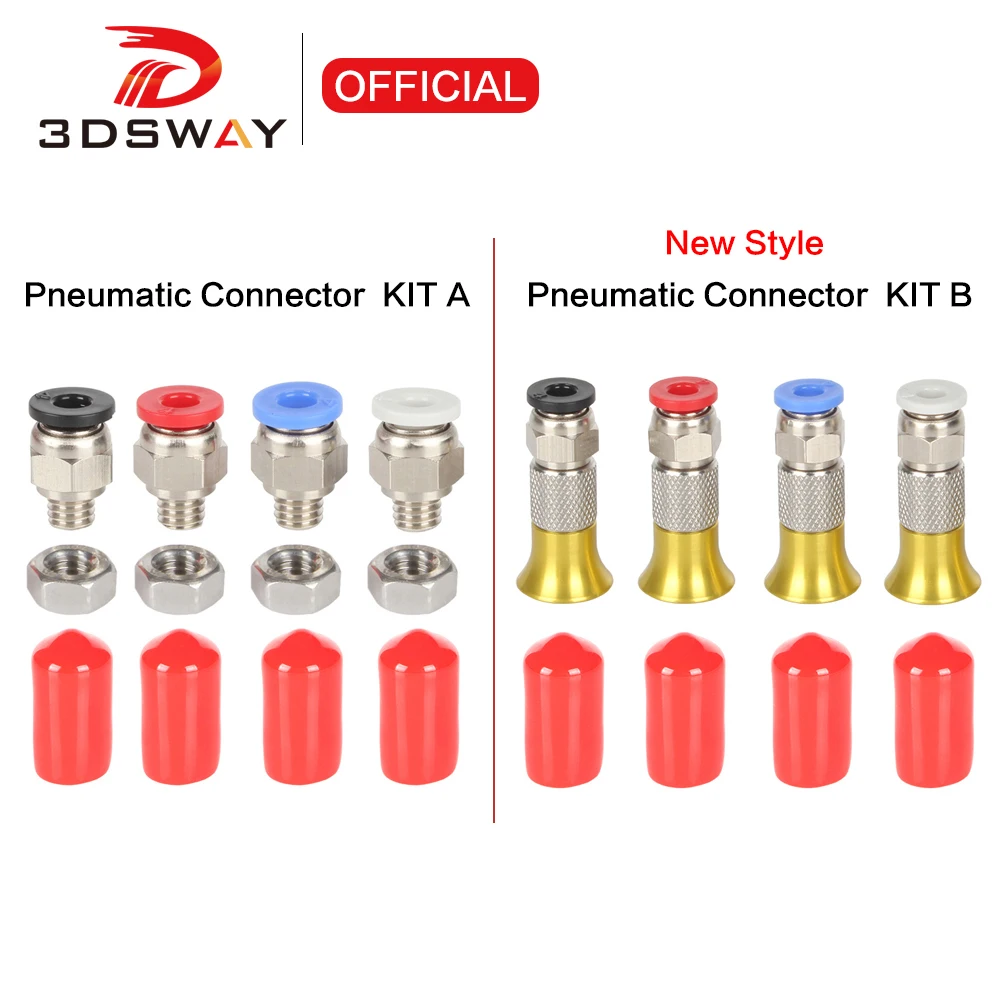
The kit presents two distinct styles of PC4-M6 pneumatic connectors: Kit A and Kit B. Kit A features the standard, widely recognized PC4-M6 design. These connectors consist of a metal body with an M6 thread and a plastic push-to-connect collar. They secure the PTFE tubing firmly. This design is a staple in Bowden extrusion systems. It offers reliable performance for many applications.
Kit B introduces an upgraded flare design. This is a significant enhancement. The base of these connectors incorporates a gold-colored, flared entry point. This bell-shaped opening guides the filament into the PTFE tube more smoothly. This reduces the sharp angle and friction often encountered at the entry point of standard connectors. Filament travels with less resistance. This minimizes the chance of filament snagging or abrasion.
The implication of this flared design is a noticeably smoother filament path. In high-volume printing scenarios, or when using more brittle filaments, this reduction in friction can prevent premature filament breakage. It also decreases wear on the filament itself. This translates to fewer print failures. It means more consistent extrusion. It is a small but impactful design change.
Compared to generic connectors, where the filament can sometimes catch on the edge of the PTFE tube or the connector body, Kit B's flared entry acts as a funnel. This design choice directly addresses a common point of failure in Bowden setups. It makes filament loading easier. It reduces maintenance needs. This is a clear improvement in user experience.
The Critical Role of PTFE Tubing in Filament Path
Central to this kit's effectiveness is the inclusion of 2.5x4mm PTFE tubing. PTFE, or Polytetrafluoroethylene, is renowned for its extremely low coefficient of friction. This property makes it an ideal material for guiding 3D printer filament. The 2.5mm inner diameter is specifically sized for 1.75mm filament. This ensures a snug fit without excessive drag.
The real-world implication of using high-quality PTFE tubing is a dramatic reduction in filament drag. When filament moves through a long Bowden tube, friction can cause the extruder motor to work harder. This leads to inconsistent extrusion or even grinding of the filament. The smooth internal surface of PTFE minimizes this resistance. It allows for more precise filament delivery. This directly impacts print quality.
Standard Bowden tubes, especially those made from lower-grade materials or with rougher internal finishes, can introduce significant friction. This friction accumulates over the length of the tube. It can lead to under-extrusion or increased wear on the filament drive gear. The 3DSWAY kit's PTFE tube acts as a superior conduit. It maintains consistent filament flow. This is a critical factor for successful prints.
For educational purposes, demonstrating the concept of friction and its impact on mechanical systems is straightforward with this component. Students can compare the effort required to push filament through different tube materials. This highlights the engineering choice behind PTFE. It reinforces practical applications of physics principles.
Streamlined Assembly and Dry Box Integration
The assembly process for integrating these connectors into a DIY filament dry box is designed for simplicity. The PC4-M6 connectors feature an M6 thread, allowing them to be screwed directly into appropriately sized holes in a plastic container. A nut is provided for securing the connector from the inside. This creates a robust, airtight seal. The red caps included in Kit A serve as dust covers.
In a practical scenario, a user would drill an M6-sized hole into their chosen dry box container. The connector is then inserted and secured with the nut. The PTFE tube is pushed into the connector. This forms a continuous, sealed pathway for the filament. This setup effectively isolates the filament from ambient humidity. It ensures optimal storage conditions. This is a simple, effective solution.
Compared to makeshift solutions involving unsealed holes or less secure fittings, these pneumatic connectors provide a professional and reliable seal. This prevents humid air from entering the dry box. It protects the filament from environmental degradation. The secure connection also means less chance of the tube detaching during printing. This enhances operational safety and reliability.
The ease of assembly makes this kit suitable for classroom projects. Students can learn about sealing mechanisms and material protection. They can build their own functional dry box. This hands-on experience reinforces STEM concepts. It provides a valuable tool for their 3D printing endeavors.
Enhancing Print Quality and Filament Longevity
Maintaining dry filament is paramount for achieving high-quality 3D prints. Filaments like PLA and ABS are hygroscopic, meaning they readily absorb moisture from the air. This absorbed moisture vaporizes when heated in the hotend. This creates steam bubbles. These bubbles lead to visible defects in prints. These defects include stringing, blobs, and a rough surface finish.
By using this connector and PTFE tube kit within a sealed dry box, the filament remains in a low-humidity environment. This directly translates to smoother extrusion and improved layer adhesion. The absence of moisture bubbles results in stronger, more aesthetically pleasing prints. This enhances the overall output quality. It reduces post-processing time.
Many common printing issues are often attributed to printer calibration or settings, when in fact, moist filament is the culprit. Implementing a dry box solution with these components can dramatically reduce these moisture-related problems. It allows users to troubleshoot other print issues more effectively. This provides a clearer diagnostic path. It saves time and material.
The extended lifespan of filament is another significant benefit. Dry filament retains its mechanical properties better. It is less brittle. This means fewer breakages during printing or handling. For educational institutions with budget constraints, extending the usability of filament spools represents a tangible cost saving. This is a smart investment.
Operational Safety and Educational Applications
Safety in a 3D printing environment, especially in educational settings, is a primary concern. While these connectors themselves are passive components, their contribution to a stable filament path indirectly enhances safety. A smoothly feeding filament reduces the risk of jams. Jams can lead to user intervention near hot components. This minimizes potential hazards.
The secure connection provided by the PC4-M6 fittings ensures that the PTFE tube remains firmly attached. This prevents accidental dislodgement during printing. Such dislodgements could potentially interfere with moving printer parts. They could cause damage. A stable setup is a safer setup. This promotes responsible operation.
For STEM education, this kit offers a practical lesson in preventative maintenance and system optimization. Students learn the importance of environmental control for materials. They understand how small mechanical components contribute to overall system reliability. This fosters a holistic understanding of 3D printing. It encourages thoughtful design.
The color-coded release collars on the connectors are a subtle but helpful feature. They allow for quick identification and easy release of the PTFE tube. This simplifies maintenance and filament changes. It makes the system more user-friendly. This is particularly beneficial in a classroom where multiple students might interact with the equipment.
Value Proposition and Final Assessment
Considering the relatively low cost of this kit, the value proposition for improving 3D print quality and filament longevity is substantial. It is an affordable upgrade. It addresses a fundamental challenge in FDM 3D printing. The investment pays dividends in reduced print failures and extended material life. This enhances productivity.
The choice between Kit A and Kit B allows users to select based on their specific needs or budget. Kit B, with its flared design, offers a marginal but noticeable improvement in filament feeding smoothness. This makes it a worthwhile consideration for those seeking optimal performance. Both kits provide a significant upgrade over unmanaged filament.
This kit represents a foundational step towards a more reliable and efficient 3D printing workflow. It simplifies filament handling. It protects valuable materials. It ultimately contributes to a more rewarding printing experience. It is a smart addition to any 3D printing setup.
Imagine a classroom where students confidently load filament, knowing their prints will succeed due to properly managed materials. Picture a workshop where brittle filaments print flawlessly, free from moisture-induced defects. This kit provides the foundational elements for such a seamless and high-quality 3D printing environment, empowering users to achieve consistent, professional results with every project.