18AWG DC Power Extension Cable (5.5x2.1mm Male-to-Male)
Official Store Deal
Expert Analysis Overview
Electrical Interconnect Performance and Safety Analysis
The 18AWG DC Power Extension Cable is a specialized electrical connector designed for low-voltage applications, primarily extending power to devices like CCTV cameras or LED lighting, but its stated 10A rating with 18AWG wire demands careful scrutiny for safe operation. This assessment focuses on the cable's construction, its rated electrical parameters, and the practical implications for various DC power scenarios. The visible markings and physical attributes provide a foundation for evaluating its suitability and limitations within electrical systems.
Conductor Specifications and Material Integrity
The cable explicitly states an 18AWG conductor size. This gauge dictates the maximum safe current capacity over a given distance. American Wire Gauge (AWG) is a standardized system for denoting the diameter of electrically conducting wire. A smaller AWG number corresponds to a larger wire diameter and, consequently, a lower electrical resistance and higher current carrying capacity. For 18AWG, the nominal cross-sectional area of the copper conductor is approximately 0.823 square millimeters. This is a relatively thin wire. Understanding AWG is fundamental.
The visible insulation on the cable jacket indicates a rating of 80°C and 300V. The 80°C temperature rating specifies the maximum continuous operating temperature the insulation material can withstand without thermal degradation. This is a standard rating for many general-purpose PVC (Polyvinyl Chloride) insulated cables, indicating resilience in typical indoor or protected outdoor environments. The 300V voltage rating confirms the insulation's dielectric strength, signifying its ability to safely contain electrical potential differences up to 300 volts. This rating far exceeds the requirements for common 12V DC systems, providing a substantial safety margin against insulation breakdown. The "FT1" marking denotes a flame test rating, specifically a vertical wire flame test, common in Canadian electrical standards. This indicates a degree of flame retardancy, meaning the cable will resist igniting and spreading flame under specific test conditions, enhancing fire safety.
Unlike thinner, unrated cables that offer no verifiable performance metrics, the 18AWG designation provides a clear, industry-recognized baseline for electrical planning. The insulation's explicit temperature and voltage ratings offer a defined operational envelope, crucial for preventing insulation breakdown and ensuring long-term reliability. These specifications are paramount for preventing electrical hazards and ensuring the longevity of the cable and connected equipment. Without these explicit ratings, assessing the cable's safety and performance would be speculative and risky. The cable's outer diameter is specified as 4.8mm, which is consistent with an 18AWG cable incorporating a robust jacket and insulation layers.
Connector Design and Interoperability
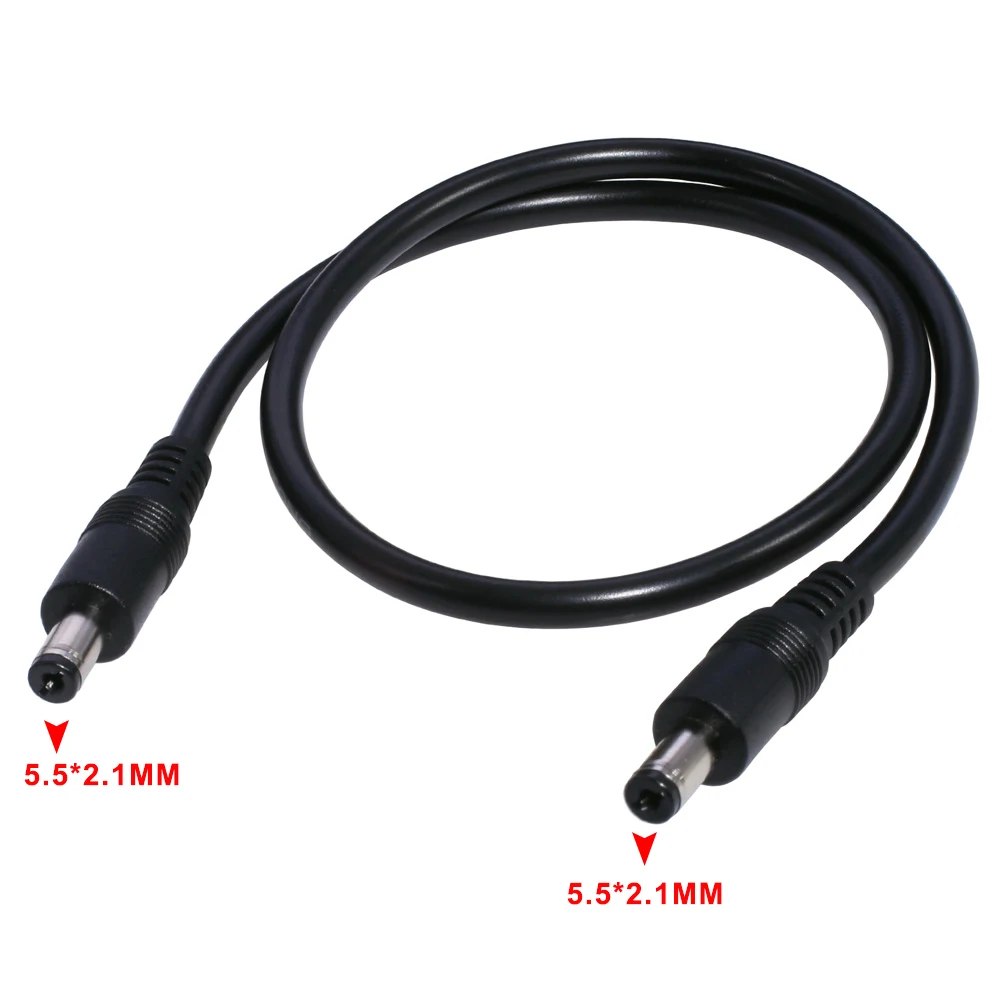
This cable features 5.5x2.1mm male DC barrel connectors on both ends. This specific dimension refers to the outer diameter (5.5mm) and the inner pin diameter (2.1mm) of the connector. This is a widely adopted standard for low-voltage DC power connections across a multitude of electronic devices, making the cable highly versatile. The male-to-male configuration implies its primary use as an extension cable or an adapter between two female ports, offering flexibility in power routing.
The design of barrel connectors, while ubiquitous, relies on a friction fit for electrical contact. A secure, tight connection is paramount to minimize contact resistance, which can otherwise lead to localized heating and power loss. The visible construction suggests a molded connector, which typically offers superior strain relief and enhanced durability compared to crimped or soldered connections that lack proper overmolding. This molding helps prevent wire breakage at the critical junction where the cable meets the connector. The metal pin within the connector is responsible for the positive contact, while the outer barrel forms the negative contact, adhering to the common center-positive polarity standard for most devices using this connector type.
Compared to proprietary or less common connector types, the 5.5x2.1mm standard offers significant interoperability. Users can readily connect this cable to a vast array of power adapters, CCTV cameras, LED lighting strips, routers, external hard drives, and various small electronic gadgets that utilize this common DC input. This broad compatibility reduces the need for multiple specialized cables and adapters, streamlining electrical setups. The simplicity of the barrel connector design also makes it straightforward to use, requiring no specialized tools for connection. It is a practical choice.
Current Handling and Electrical Safety Protocols
The product title explicitly states a 10A current rating for this 18AWG cable. This specification requires careful evaluation from an electrical safety standpoint. The current carrying capacity, or ampacity, of a wire is fundamentally limited by its gauge, its length, the insulation type, and the acceptable temperature rise. When electrical current flows through a conductor, its inherent resistance causes heat generation, a phenomenon described by Joule heating (P = I²R). Excessive heat can degrade insulation prematurely, increase electrical resistance, exacerbate voltage drop, and, in severe cases, pose a significant fire hazard.
For 18AWG wire, standard ampacity charts, such as those provided by the National Electrical Code (NEC) or various engineering handbooks, typically recommend a maximum current of around 7-8 amps for chassis wiring or power transmission, depending on the specific insulation type and ambient temperature. A continuous 10A load on an 18AWG cable, especially at 12V, is pushing the absolute limits of safe and efficient operation. Voltage drop becomes an even more significant concern at higher currents and longer lengths. For instance, a 1-meter (approximately 3.3 feet) run of 18AWG wire carrying 10 amps at 12V would experience a voltage drop of roughly 0.6-0.7 volts. This represents a substantial percentage of the total voltage (around 5-6%), potentially impacting the performance of sensitive electronics that require a stable input voltage. Devices may malfunction.
Unlike cables with a more conservative and realistically aligned current rating, this cable's 10A claim for 18AWG necessitates user vigilance and a thorough understanding of electrical principles. If a user attempts to draw a continuous 10 amps, the cable could experience excessive heating, potentially leading to premature insulation failure, increased resistance, and a higher risk of fire. The shorter lengths (0.5m and 1m) mitigate voltage drop and heat generation to some extent compared to longer runs, but the fundamental limitation of the wire gauge for sustained high current remains. For critical applications or continuous high-current loads, a heavier gauge wire (e.g., 16AWG or 14AWG) would be a more appropriate and significantly safer choice, ensuring minimal voltage drop and preventing thermal overload. Electrical fires are a serious risk.
Application Versatility and Operational Limitations
This DC power extension cable finds its primary utility in extending power connections for low-voltage devices where the power source is slightly out of reach. Its 0.5m and 1m lengths offer practical flexibility for various installation scenarios, minimizing excess cable while providing necessary reach. Common applications include extending the reach of a CCTV camera's power adapter, providing power to LED strip lighting installations, connecting small electronic projects to a power supply, or powering various IoT devices. The male-to-male configuration allows for bridging two female ports, which can be useful in specific adapter setups or for creating custom power distribution schemes.
The cable's design is optimized for convenience and functionality in these low-power, short-distance applications. It is not intended for high-power industrial machinery, automotive applications with high transient loads, or scenarios requiring precise voltage regulation over extended distances. Its operational limitations stem directly from its wire gauge and connector type. Devices requiring higher currents than 8 amps continuously, or those utilizing different barrel jack sizes (e.g., 5.5x2.5mm, 3.5x1.35mm), will not be compatible. The cable's inherent flexibility allows for easy routing and concealment in many environments.
Compared to custom wiring solutions that require specialized tools and expertise, this pre-fabricated cable offers a plug-and-play convenience. It eliminates the need for cutting, stripping, and terminating wires, saving significant time and effort for the end-user. However, this convenience comes with the trade-off of fixed specifications. Users must meticulously ensure their application's electrical requirements, particularly current draw, align with the cable's capabilities to prevent performance issues or safety hazards. It is a simple solution.
Installation Considerations and Best Practices
Proper installation of any electrical cable is crucial for both performance and safety. When utilizing this 18AWG DC extension cable, several best practices should be observed to ensure reliable and safe operation. First, always verify the power requirements of the device being powered. This includes checking the voltage and, critically, the maximum current draw. Ensure the current draw does not exceed the cable's safe operating limits, which, as discussed, are likely below the stated 10A for continuous use. Overloading can lead to dangerous overheating and potential equipment damage.
Second, ensure that the 5.5x2.1mm connectors provide a snug and secure fit into both the power source and the device's input. A loose connection can result in intermittent power, which can disrupt device operation, and can also lead to arcing and localized heating at the contact points. Such conditions can damage both the cable's connectors and the ports of the connected device. Avoid excessive bending or sharp angles, especially near the connector strain relief points, to prevent internal wire damage or premature failure of the connector housing. Cable ties or clips can help manage slack and secure the cable, preventing accidental disconnections or physical stress.
Unlike haphazard wiring, a methodical approach to cable management extends the lifespan of the cable and significantly enhances safety. Route the cable away from direct heat sources, sharp edges, or areas where it might be pinched, crushed, or repeatedly stepped on. For outdoor applications, even if the cable is rated for some environmental exposure, consider additional weatherproofing for the connections to prevent moisture ingress, which can cause short circuits or corrosion. Regular visual inspection of the cable for any signs of wear, fraying, or damage is a simple yet highly effective maintenance practice that can prevent future problems.
Long-Term Durability and Maintenance
The visible construction of the cable, with its PVC jacket and molded connectors, suggests a reasonable level of durability for its intended use in low-voltage applications. PVC (Polyvinyl Chloride) is a common material for cable jackets due to its inherent flexibility, good abrasion resistance, and excellent electrical insulation properties. The 80°C temperature rating indicates that the PVC compound is specifically formulated to resist softening, cracking, or becoming brittle under typical operating temperatures, contributing to its long-term integrity. The cable's outer diameter of 4.8mm provides a decent amount of insulation and jacket material, offering a good balance between flexibility and physical protection.
However, like all electrical cables, this product is subject to wear and tear over time, especially if subjected to frequent flexing, pulling, or prolonged exposure to harsh environmental conditions such as extreme temperatures or direct sunlight. The integrity of the insulation is paramount for electrical safety. Any visible cracks, cuts, or fraying in the outer jacket could expose the internal conductors, creating a significant short circuit risk or an electrical shock hazard. Therefore, regular visual inspections are not merely a suggestion but a critical, simple yet effective maintenance practice that can identify potential issues before they escalate.
Compared to industrial-grade cables designed for extreme conditions, this product is engineered for lighter-duty, general-purpose applications. Its maintenance requirements are minimal, primarily focusing on visual inspection and ensuring it is not subjected to undue physical stress. Proper storage, avoiding tight coiling, kinking, or hanging in ways that strain the connectors, will significantly contribute to its longevity and reliable performance. A well-maintained cable performs reliably.
Value Proposition in Electrical Systems
The cost-effectiveness of this 18AWG DC power extension cable is evident, particularly for users requiring a straightforward solution for low-voltage power extension without a significant upfront investment. Its affordability makes it an attractive option for hobbyists, DIY enthusiasts, and small-scale installations where budget constraints are a factor. The standardized 5.5x2.1mm connectors and readily available lengths (0.5m and 1m) contribute to its overall convenience and perceived value, offering a quick and easy solution for common power extension needs. It offers a quick fix.
However, true value in electrical components extends far beyond the initial purchase price. The potential costs associated with using an undersized cable for a high-current application can be substantial, including premature equipment failure, system downtime, the need for costly replacements, or, in severe cases, property damage due to electrical fires. Therefore, the value proposition of this cable is maximized only when it is applied strictly within its safe operating parameters, particularly respecting its actual current carrying capacity. Investing in the correct gauge cable for the intended load is a proactive measure that prevents future problems and ensures long-term system integrity.
Unlike cheaper, unrated alternatives that flood the market with ambiguous specifications, the explicit 18AWG, 80°C, 300V, and FT1 ratings provide a verifiable level of assurance regarding its basic electrical properties and safety features. This transparency allows for informed purchasing and application decisions. For applications where the current draw is consistently below 5-8 amps, this cable represents a practical, economical, and reasonably safe choice. It delivers reliable power.
Conclusion: Ensuring System Integrity
The 18AWG DC Power Extension Cable, with its 5.5x2.1mm male-to-male connectors, offers a convenient and accessible solution for extending low-voltage DC power. Its construction, featuring an 80°C, 300V, and FT1 rated jacket, provides a foundational level of safety and durability for general use. The standardized connector type ensures broad compatibility across numerous electronic devices, simplifying power management for various setups.
However, the stated 10A current rating for an 18AWG wire necessitates a cautious approach. Electrical professionals understand that continuous loads approaching this limit can lead to significant voltage drop and excessive heat generation, potentially compromising system stability and safety. For optimal performance and to mitigate risks, this cable is best suited for applications drawing consistently below 8 amps, especially over the 1-meter length. Shorter runs (0.5m) offer slightly more leeway but do not negate the fundamental wire gauge limitation.
Imagine a scenario where your CCTV system operates flawlessly, or your LED lighting array maintains consistent brightness, all powered by a cable precisely matched to its electrical demands. This cable, when correctly applied, ensures that your low-voltage devices receive stable and reliable power without the hidden risks of an overloaded connection. It provides peace of mind. The clarity of its specifications, when understood and respected, makes it a valuable component in any well-planned electrical setup, preventing costly failures and ensuring long-term operational integrity.